
Across West Africa, cities are expanding their road networks faster than the electricity grid can follow. New boulevards, ring roads and overpasses are opened to traffic long before a dependable power connection reaches them — leaving some of the busiest corridors unlit after sunset. Extending the grid to every kilometre of road is slow, costly and often simply not an option on a project schedule.
This project took the off-grid route. A single West African city ordered 1,300 sets of all-in-one solar street lights, mounted on double-arm poles along major boulevards and an overpass. The lights operate entirely on their own: solar panel, LiFePO4 battery, LED and MPPT controller inside one sealed housing, with no trenching, no cabling and no grid connection. This case study explains the layout, the configuration and what the installation delivers, day and night.
Why all-in-one solar is the right fit for West Africa
An all-in-one solar street light integrates the solar panel, lithium battery, LED module and MPPT charge controller into a single sealed unit. There is no separate battery box to bury, no controller cabinet to protect and no power cable to trench. For a road project in a region where grid access is limited and site conditions are demanding, that simplicity has direct consequences:
- No grid connection. Each light is a fully independent off-grid system, so a road can be lit even where no power line exists.
- Lower installation cost. One unit mounts on one pole, cutting civil works, cabling and labour.
- Fewer failure points. Fewer external connections mean less to maintain and less to go wrong.
- Resilience. Every light works on its own, so a single fault never darkens a whole stretch of road.
The double-arm layout
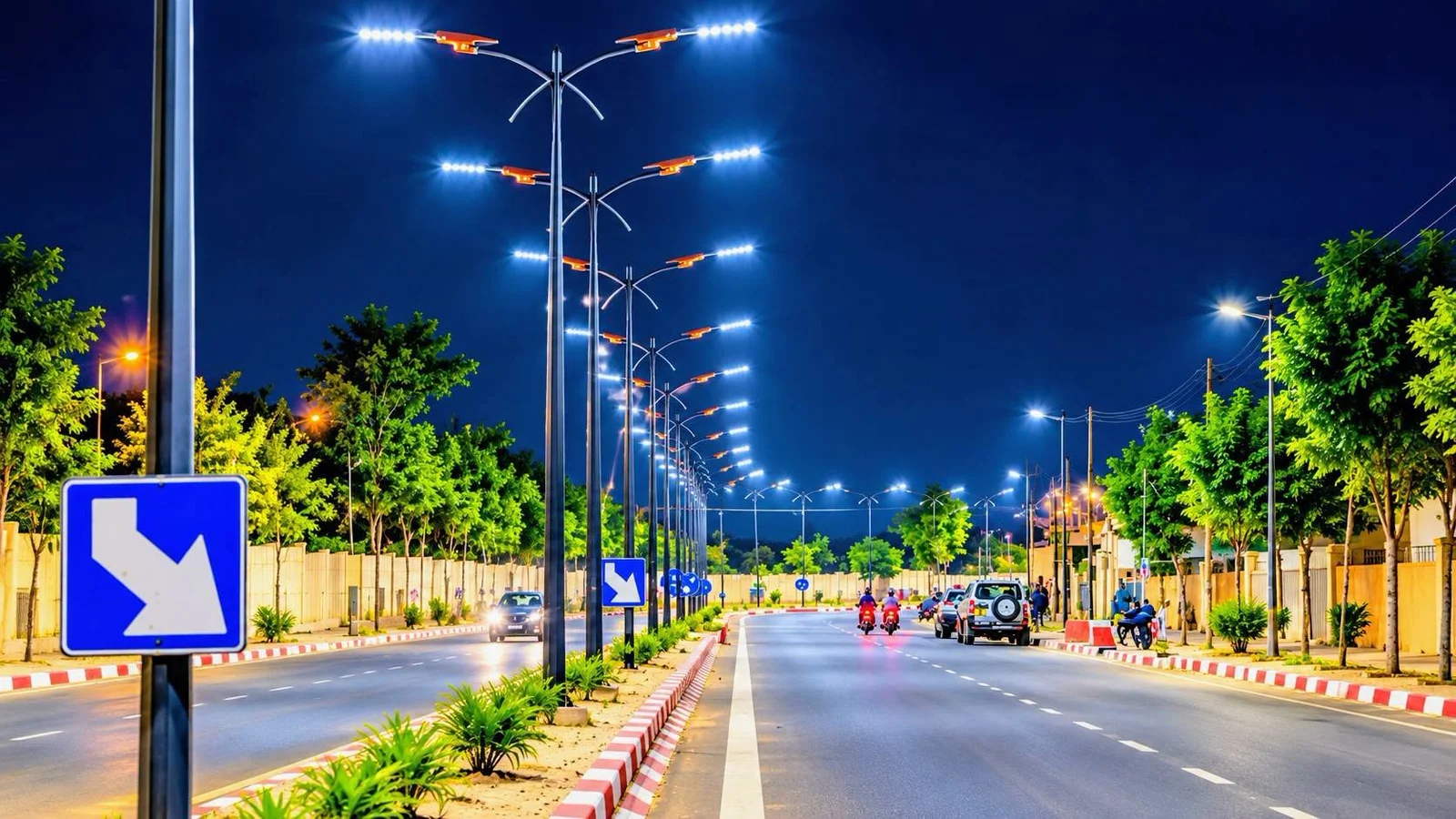
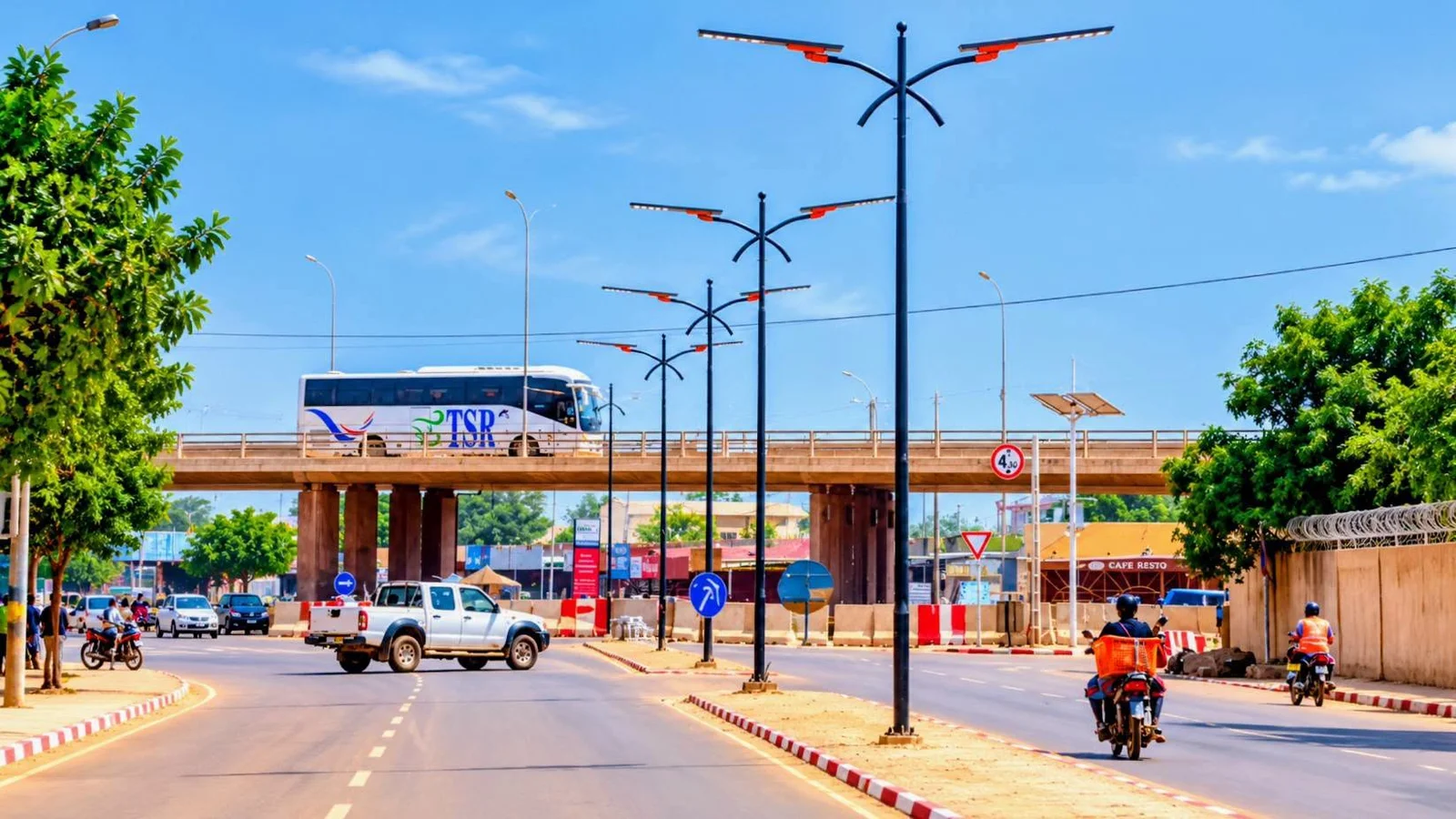
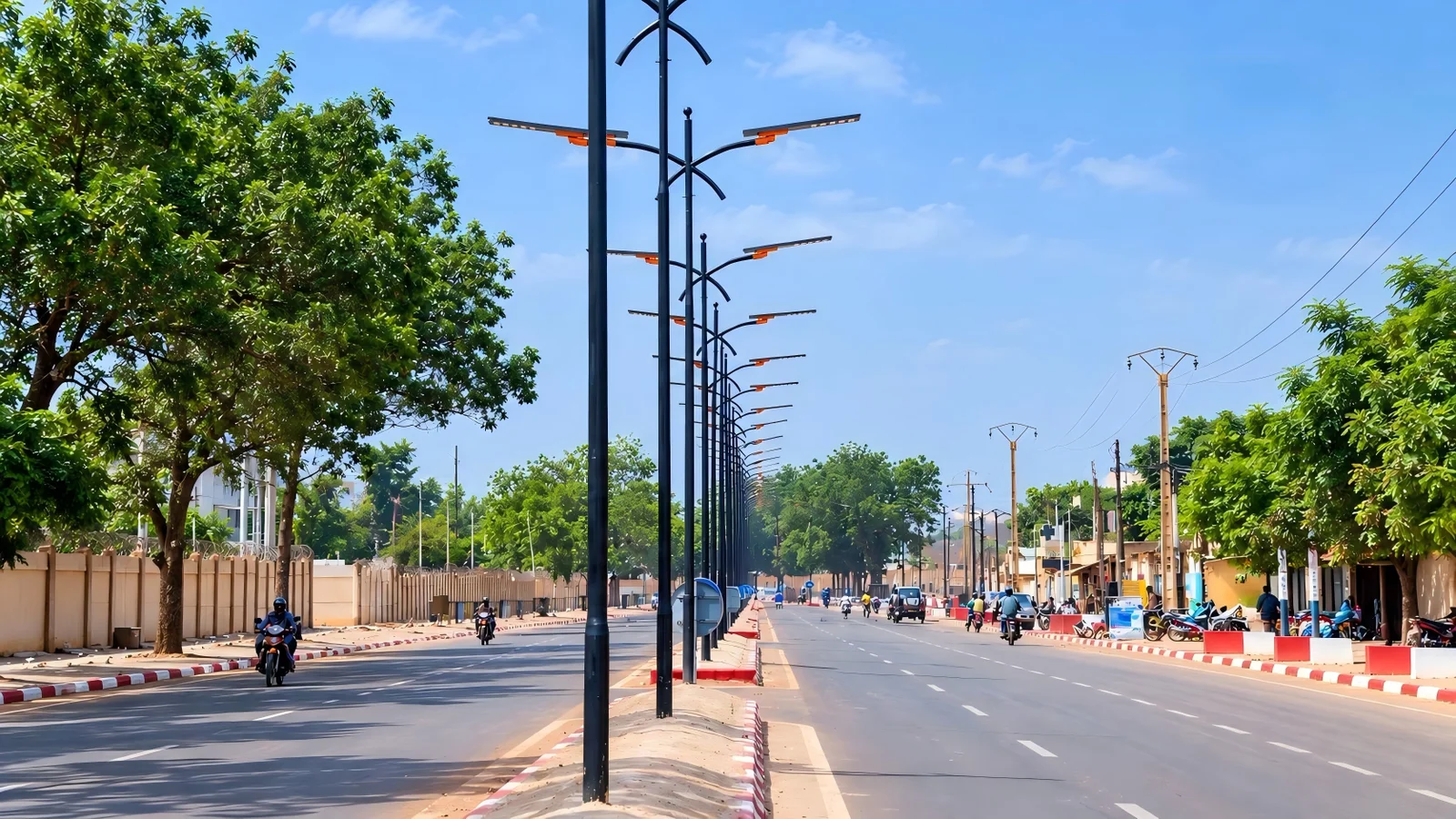
For dual carriageways and the overpass approach, the project used double-arm poles: one pole in the median carries two luminaires, one reaching over each direction of traffic. This layout does several things at once. It halves the number of foundations and poles needed to light both carriageways, keeps the illuminated corridor centred between traffic lanes, and puts each light closer to the surface it has to cover — which means more usable light on the road and less spill into adjacent properties.
The curved arms also let the luminaires sit clear of the carriageway at a consistent mounting height, keeping the street scene clean while giving each direction an even, glare-controlled distribution. Because the fixtures are all-in-one units, the arm geometry is the only structural decision — there is no separate panel frame or battery enclosure to accommodate.
Built for heat, dust and harmattan
West Africa is a demanding environment for outdoor electronics: high daytime temperatures, airborne dust during the harmattan, intense UV and heavy rain in the wet season. The specified units are rated IP65 against dust and water ingress, with die-cast aluminium housings that act as a heat sink, and they are configured to keep working across a wide operating temperature range.
The oversized monocrystalline panel is what makes the system resilient in practice. It is deliberately larger than the LED load so the battery can recover quickly after a run of cloudy or dusty days, giving several consecutive nights of autonomy without useful sun. A smart MPPT controller extracts the maximum charge available and manages the discharge profile, so the lights keep their programmed brightness through the night instead of fading early.
From survey to switch-on
Delivering 1,300 lights is as much a logistics exercise as an engineering one. The rollout followed a repeatable sequence:
- Site survey and layout. Road widths, carriageway geometry and pole positions were mapped so each pole could be placed for even coverage and correct spacing.
- Configuration. Luminaire output and battery autonomy were matched to the road class, and the controllers were set to the project's operating profile.
- Supply and pre-assembly. Units were factory-configured and packed for volume shipment, with the pole and arm hardware coordinated to the civil works.
- Mounting and commissioning. Because each light is a single sealed unit, installation is a one-pole operation — mount, aim, verify — with no trenching or grid connection to wait for.
The result is a lighting network that can be commissioned road by road, without waiting on a substation, a transformer or a cable route.
Day and night results
The clearest measure of the project is the before-and-after at dusk. During the day the boulevards read as clean, uncluttered streets: the panels charge quietly and there is no overhead cabling strung between poles. After sunset, the same corridor becomes a continuous, evenly lit route — traffic, motorcyclists and pedestrians all visible well ahead, and the overpass approach lit as part of the same network.
For the city, the practical benefits go beyond visibility. Lighting a road without extending the grid avoids the cost and delay of new power infrastructure, reduces reliance on diesel back-up, and gives each corridor its own independent power source. When one luminaire is serviced, the rest of the road stays lit.
Choosing the right all-in-one model for your project
E-Able Power supplies a full range of all-in-one solar street lights so each project can be matched to its road type — from residential streets and paths to multi-lane boulevards, ring roads and highways. If you are planning a rollout, our guides explain what an all-in-one solar street light is, how all-in-one compares with all-in-two, and how to install one correctly. Browse the full all-in-one solar street light range or see more deployments on our projects page.
Frequently asked questions
How many solar street lights were installed in this project?
The project supplied 1,300 sets of all-in-one solar street lights, mounted on double-arm poles along major boulevards and an overpass in a West African city.
Why use double-arm poles for solar street lighting?
A double-arm pole carries two luminaires from one foundation, lighting both carriageways of a divided road. It reduces the number of poles and foundations, keeps the lit corridor centred between lanes, and places each light closer to the surface it illuminates.
Do all-in-one solar street lights work in hot, dusty conditions?
Yes. The units are IP65-rated with die-cast aluminium housings that dissipate heat, and they are configured for a wide operating temperature range — suited to the heat, dust and harmattan conditions common in West Africa.
How long can the lights run without sun?
With an oversized monocrystalline panel, a LiFePO4 battery and MPPT charging, the systems are configured for several consecutive nights of autonomy during overcast or dusty spells, while maintaining their programmed night-time brightness.
Planning a solar street lighting project?
Send your road width, pole height, spacing and quantity — we will recommend the right all-in-one model and return a full layout, lighting simulation and quotation within 2–3 business days.