
In many West African cities, the road network grows faster than the electricity grid. A new boulevard can be paved and opened to traffic long before a reliable power connection reaches it, leaving drivers, motorcyclists and pedestrians to move through unlit streets after sunset. Extending the grid to every kilometre of road is slow and expensive; solar street lighting removes that dependency entirely.
This case study looks at a real project in Burkina Faso, where an 80W all-in-one solar street light was deployed along a main boulevard. It explains the exact configuration used, how the installation was designed, and why an all-in-one format is well suited to the climate and infrastructure realities of the region.
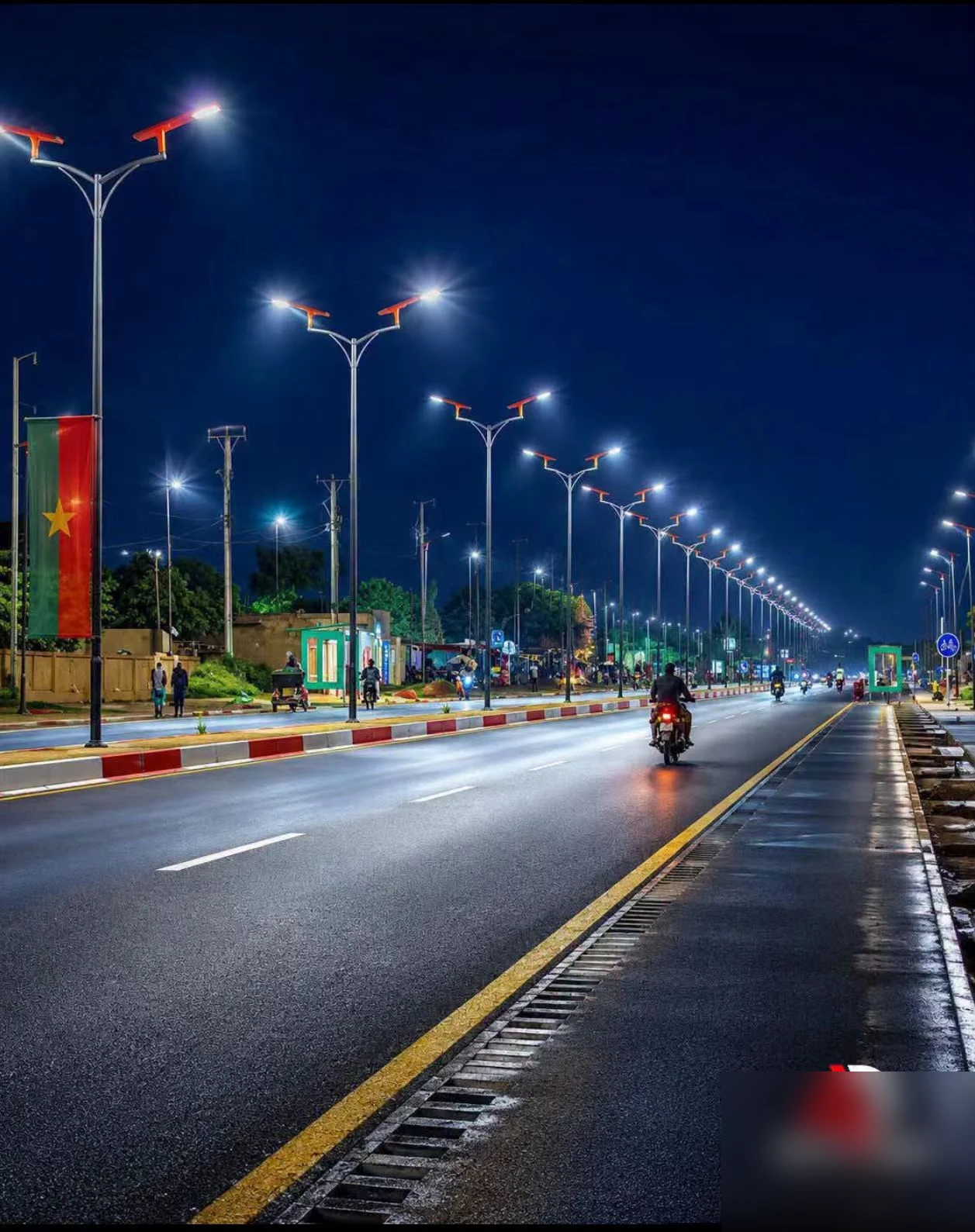
Why all-in-one solar street lights suit West Africa
An all-in-one solar street light integrates the solar panel, lithium battery, LED module and MPPT controller into a single sealed housing. There is no separate battery box to bury, no controller cabinet to protect, and no trenching for power cables. For a road project in a region where grid access is limited and site conditions are demanding, that simplicity has direct consequences:
- No grid connection. The light is a fully independent, off-grid system, so a road can be lit even where no power line exists.
- Lower installation cost. One unit mounts on one pole, cutting civil works, cabling and labour.
- Fewer failure points. Fewer external connections mean less to maintain and less to go wrong.
- Resilience. Each light works on its own, so a single fault never darkens a whole stretch of road.
The 80W configuration used on site
The luminaire specified for this boulevard is an 80W all-in-one solar street light. Its full technical configuration is summarised below:
| Parameter | Specification |
|---|---|
| Lamp power | 80W |
| Solar panel | Monocrystalline 130W |
| Battery | LiFePO4, 25Ah / 25.6V |
| LED | 4 × 60 pcs 3030 LEDs |
| Luminous flux | 11,200 lm |
| Colour temperature | 6000K |
| Beam angle | Type II |
| Controller | MPPT |
| Working mode | 100% for 3 h, then 9 h with PIR dimming (60% / 30%) |
| Charging time | 4–6 hours |
| Autonomy | 2–4 rainy days |
| Working temperature | −20°C to 60°C |
| Material | Die-cast aluminium |
| Product size | 1435 × 400 × 280 mm |
| IP rating | IP65 |
| Mounting | Pole mounted, 8–9 m height |
The 130W monocrystalline panel is deliberately larger than the 80W LED load. That oversizing is what allows the battery to recover quickly after a cloudy spell, and it is why the unit is rated for several consecutive days without useful sun. For a broader look at the same approach, see the Solara DL-80W all-in-one solar street light, whose DL-series architecture pairs an 80W LED with a 120W mono panel, a 614Wh LiFePO4 battery and MPPT control.
Designing the installation
A solar street light is only as good as its installation. Three details decide whether the system performs as specified.
Pole height and diameter
The 80W unit is designed for mounting heights of 8–9 m, which balances road coverage against glare. The bracket suits pole tops in the 60–76 mm range. A 10 mm hole is pre-drilled about 102 mm below the top of the pole to secure the bracket, and the cantilever should not exceed 60 mm in diameter.
Panel orientation
Burkina Faso lies in the Northern Hemisphere, so the solar panel must face south to harvest the most energy across the year. In the Southern Hemisphere the rule is reversed. Correct orientation is the single biggest factor in charging performance.
Pole spacing
Spacing depends on road width and the chosen optics. With a Type II distribution, the light is pushed down the road rather than spilling sideways, so the beam reaches the next pole with an even, overlap-free result and no dark gaps between poles. On a boulevard, this keeps the lit corridor continuous even as the road bends.
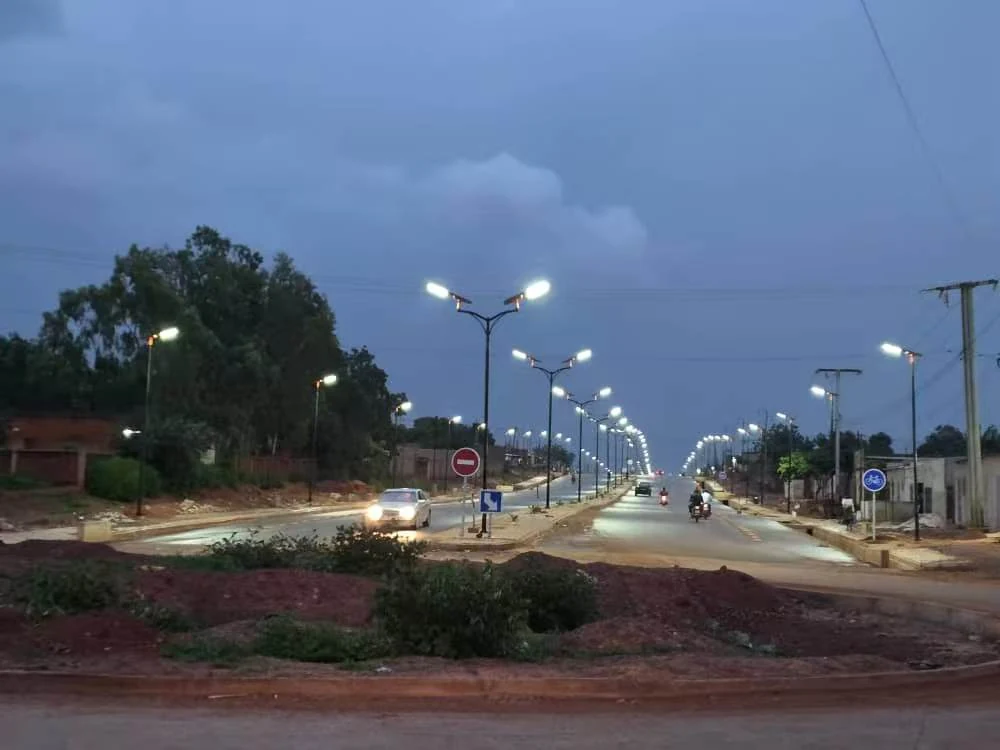
How the 80W light runs through the night
The luminaire is controlled by a light-operated switch with a threshold of about 30 lux: it turns on automatically as darkness falls and off again at sunrise. From there, an adaptive schedule stretches the available battery energy across the night.
- First three hours: 100% power, covering the busiest evening period.
- Remaining nine hours: dimmed operation at 60% or 30%, brightening instantly when the PIR sensor detects a vehicle or pedestrian.
This pattern gives full brightness when traffic is heaviest and deep energy savings when the road is quiet, without ever leaving it dark. Combined with the 25Ah/25.6V LiFePO4 battery, it delivers the 2–4 day autonomy that matters during the rainy season, when a stretch of overcast days can otherwise drain a smaller system.
Why 80W is the right size for a boulevard
Power selection is a trade-off between coverage, pole spacing and cost. An 80W luminaire producing 11,200 lumens is a practical middle ground for a main urban road: it is bright enough to light a multi-lane boulevard safely, while its 130W panel and 25Ah battery remain compact enough to mount on a standard 8–9 m pole without a heavy structural upgrade.
Smaller 30–50W units are better suited to residential streets and paths, while 100–150W units are used for highways and larger intersections. Matching the luminaire to the road, rather than over-specifying, keeps both capital cost and energy demand under control.
Choosing the right all-in-one model
E-Able Power supplies a full range of all-in-one solar street lights so that each project can be matched to its road type. The Solara DL series runs from 40W to 150W in a fully integrated IP66 chassis, and the AeroLume LKA series offers 80W to 150W outputs. For projects that prefer a separate panel and lamp, the 80W split solar street light is the equivalent split-system option.
If you are still weighing formats, our guides explain what an all-in-one solar street light is, how all-in-one compares with all-in-two, and how to install one correctly. The full range is listed on our all-in-one solar street light page, and you can see similar deployments on our projects page.
Frequently asked questions
How high should an 80W all-in-one solar street light be mounted?
An 80W all-in-one solar street light is designed for poles of 8–9 m. Keep the top of the pole within the 60–76 mm diameter range and face the solar panel toward the equator: south in the Northern Hemisphere and north in the Southern Hemisphere.
How many nights can an 80W solar street light run without sun?
With a 25Ah/25.6V LiFePO4 battery and MPPT charging, the 80W all-in-one light is rated for 2–4 rainy days of autonomy. It runs at full power for the first three hours, then drops to a 30–60% dim level with PIR motion sensing for the rest of the night.
Do all-in-one solar street lights work in hot, dusty conditions?
Yes. The housing is die-cast aluminium with an IP65 rating and a working temperature range of −20°C to 60°C, so it is suited to the heat, dust and harmattan conditions common in West Africa.
How long does an all-in-one solar street light take to install?
Because the panel, battery, LED and controller are integrated in one sealed unit, installation is a single mounting operation. A pre-drilled 10 mm hole 102 mm from the top of the pole secures the bracket, and no trenching or grid connection is required.
Planning a solar street lighting project?
Send your road width, pole height and target spacing — we will recommend the right all-in-one model and return a full layout, lighting simulation and quotation within 2–3 business days.