
Electric vehicles are arriving in West Africa faster than the grid can support them. A single 60 kW DC charger can pull as much power as a small apartment block, and it pulls it in short, unpredictable bursts. On a weak or congested distribution network, that pattern is exactly what causes voltage dips, tripped breakers and expensive demand charges.
The answer is not to avoid EV charging — it is to buffer it. By pairing a solar carport with a commercial & industrial (C&I) battery storage cabinet, a site can charge vehicles with its own solar energy, smooth the load it places on the grid, and keep charging even when the grid is down. This article explains how such a system is designed, using a real five-site deployment in West Africa as the reference.
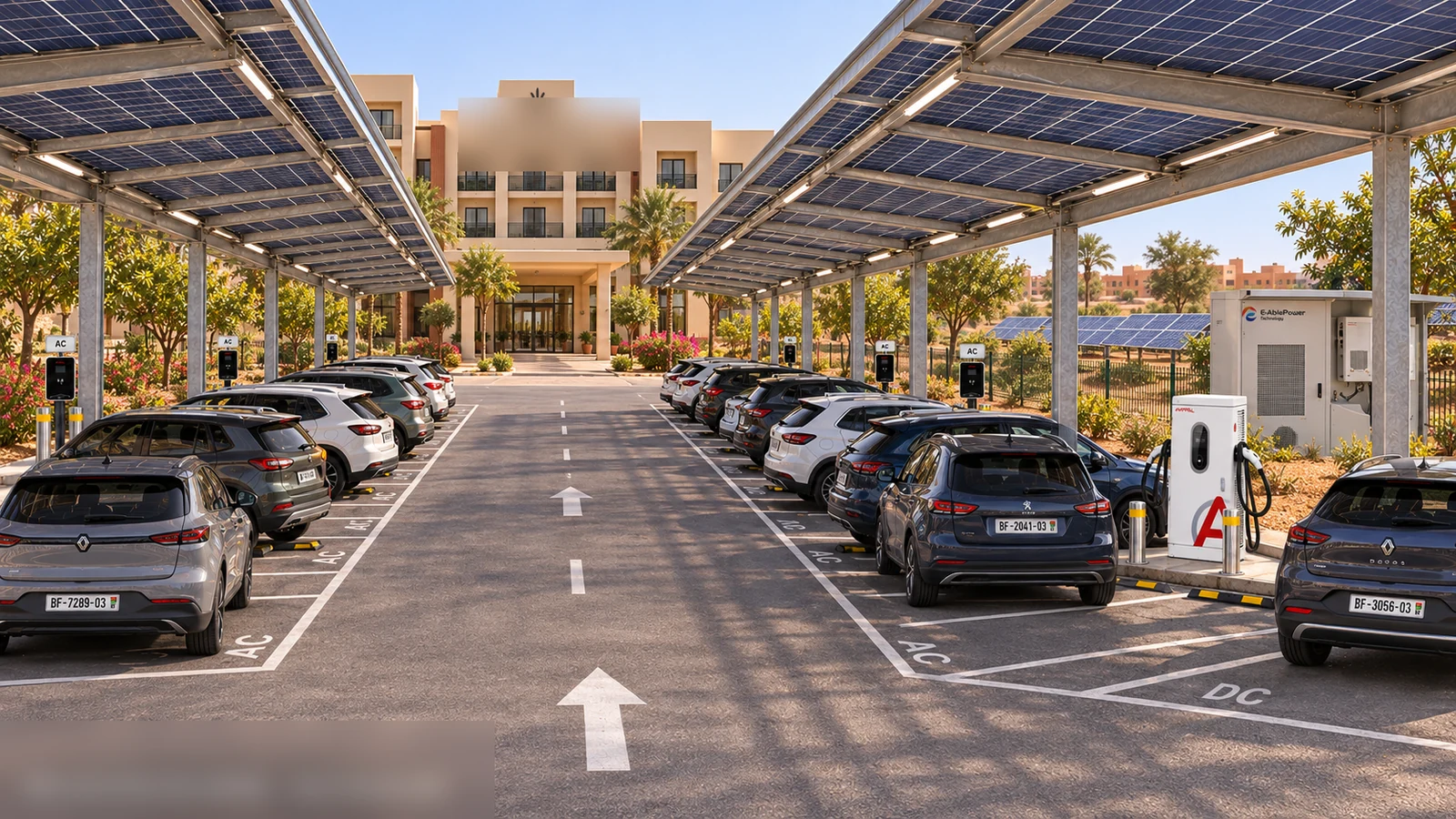
Why solar EV charging needs battery storage
Solar panels generate the most power at midday, while vehicles tend to charge in the morning and evening. A grid connection sized for the average load cannot serve the peak charging demand, so operators either over-size the connection — paying for capacity they rarely use — or throttle charging exactly when customers want it.
A battery storage system changes that equation. It absorbs solar energy during the day, then releases it to the chargers when demand spikes, capping the site's grid draw at a level the connection can actually supply. The same battery also provides backup power, so a charging station can keep operating through an outage instead of going dark.
Three benefits follow directly:
- Peak shaving. The battery supplies the short bursts of DC fast charging, so the grid only sees a smooth, predictable load.
- Solar self-consumption. Stored daytime PV is delivered to vehicles instead of being exported or curtailed.
- Resilience. With a hybrid inverter, the site can switch to battery and solar power in milliseconds when the grid fails.
How a solar carport charging system works
The system has four layers, all sized to work together:
- Generation — bifacial PV modules mounted on carport canopies and ground arrays.
- Storage — a C&I battery cabinet that stores surplus solar energy and buffers the chargers.
- Conversion — a high-voltage hybrid inverter (PCS) that manages PV, battery, grid and loads.
- Charging — DC fast chargers for rapid top-ups and AC wall-boxes for slower, longer parking sessions.
Energy flows in a loop: PV charges the battery through the inverter; the battery discharges to the chargers; the grid makes up any shortfall and absorbs any surplus. A site controller decides the balance moment by moment.
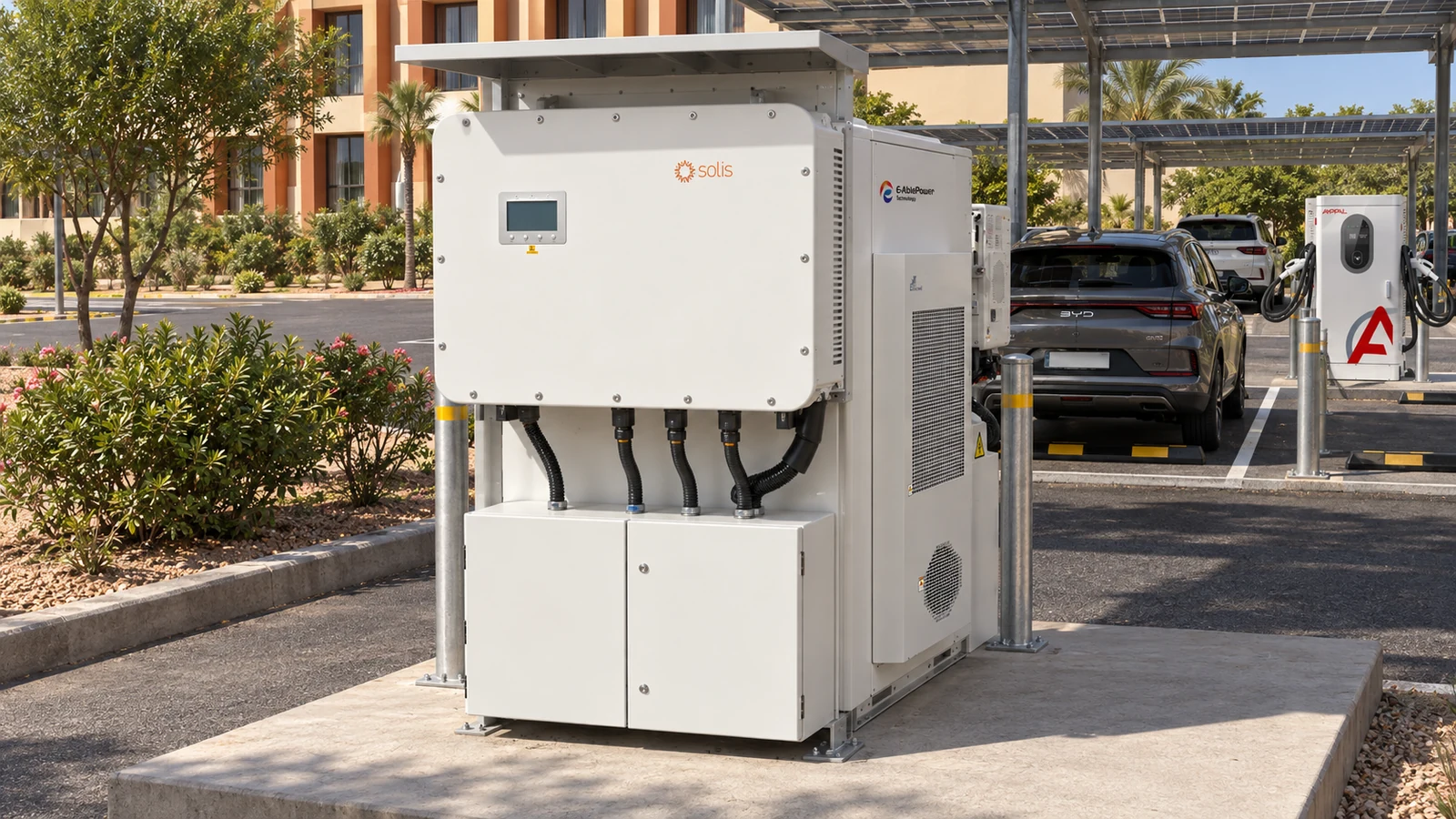
The energy storage cabinet: 241 kWh in one unit
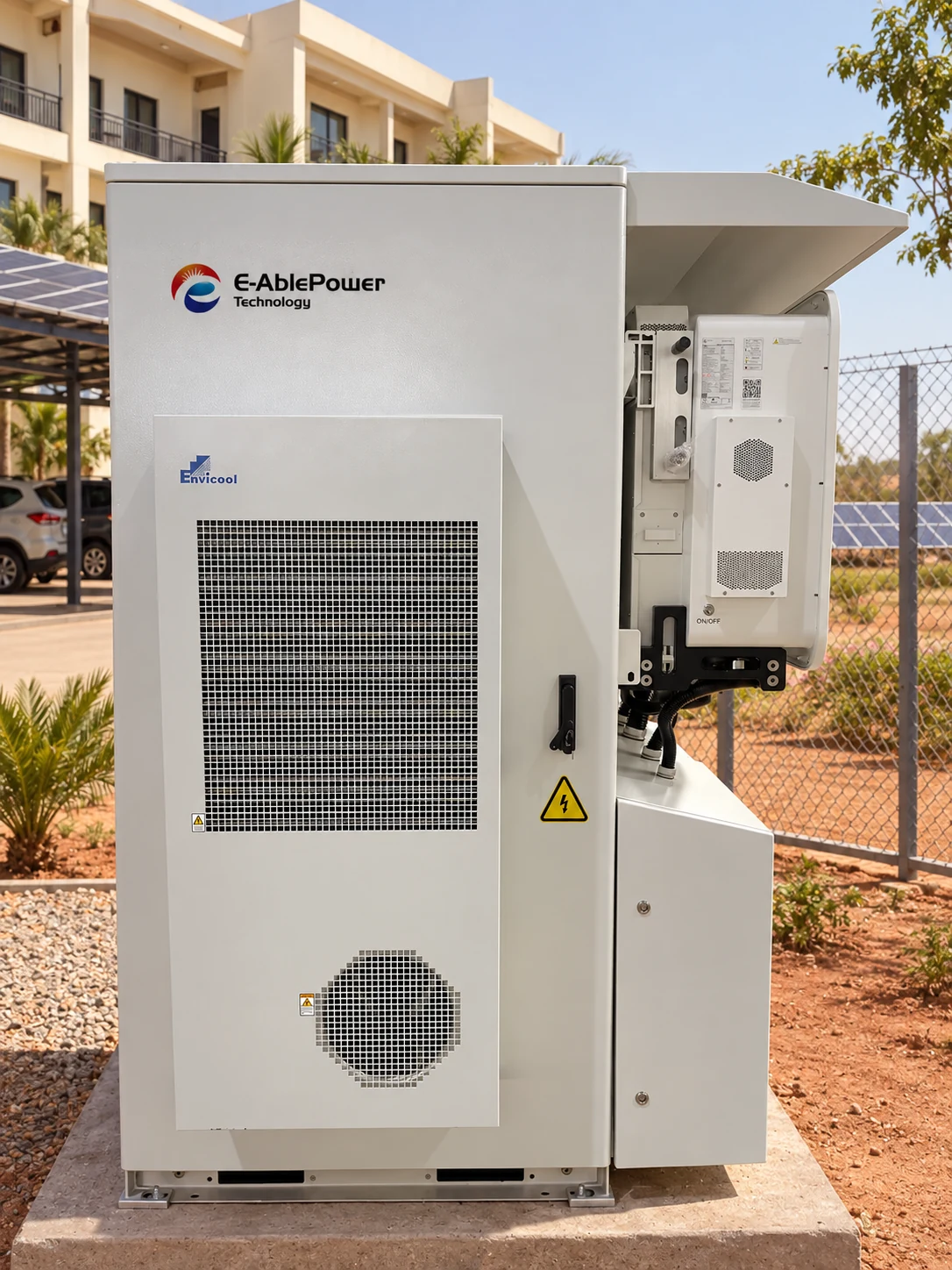
At the centre of the design is the storage cabinet. For this project we specified the GCB-E241 commercial & industrial battery cabinet: 241.15 kWh of Grade-A LiFePO4 cells in a 768 Vdc architecture (15 modules of 51.2 V in series), with a nominal AC current of 189 A at 380 V / 50 Hz.
Because it is an outdoor unit, it is built for the conditions: an IP54 enclosure, industrial HVAC cooling, and automatic fluoro-ketone (Novec 1230) fire suppression. It communicates over RS485 / CAN and is designed to pair with high-voltage hybrid inverters from Solis and Deye at 125 kW. Cycle life exceeds 6,000 cycles at 80% depth of discharge, and the cabinet carries a 10-year warranty.
For smaller sites, the same platform scales down through the GCB-E112 (112 kWh) and the GCB-E50 (50 kWh), and up through the GCB-E257 (257 kWh) and the liquid-cooled GCB-E261.
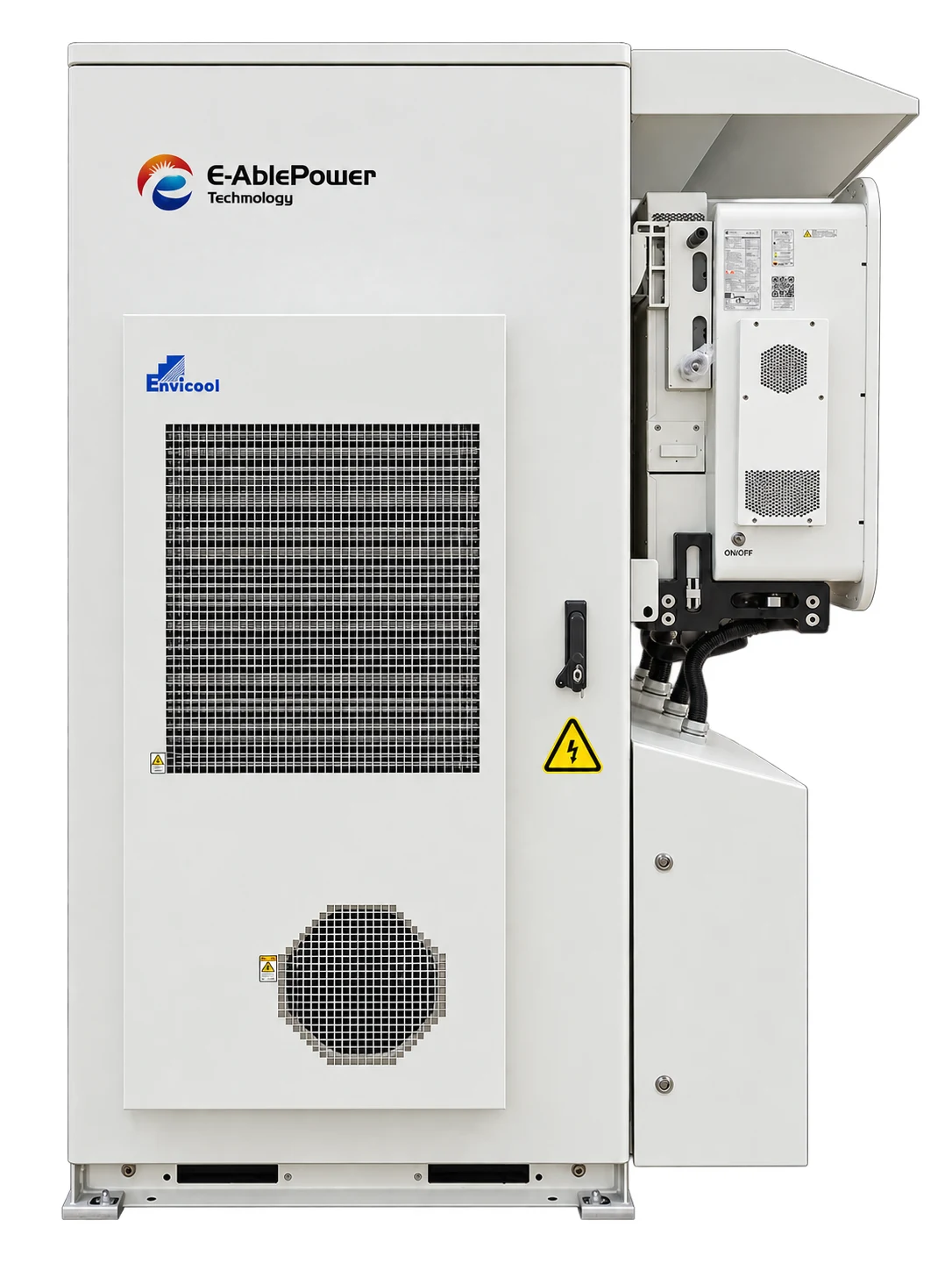
The 125 kW hybrid inverter: the brain of the system
The inverter decides where every kilowatt goes. We paired each cabinet with a high-voltage three-phase hybrid inverter rated at 125 kW, with a maximum efficiency of 98.2% and a battery range of 300–950 Vdc. It offers 10 MPPT inputs for up to 20 PV strings at 1,000 V, which lets a large carport array connect directly without an extra combiner stage.
Crucially for charging applications, it switches between grid and backup in under 10 ms and includes an integrated diesel-generator input, so a site can keep charging from battery and solar during an outage. It is IP66-rated, monitors through a 7” LCD and cloud platform, and supports up to six units in parallel.
For lower-power residential and light-commercial carports, E-Able Power offers the IP-Plus 12 kW-P split-phase hybrid inverter and the 7.2–12 kW split-phase hybrid inverter.
DC fast charging and AC charging together
Charging behaviour at a commercial site is mixed. Some drivers need a fast top-up; others leave a vehicle parked for hours. The design serves both with a single system.
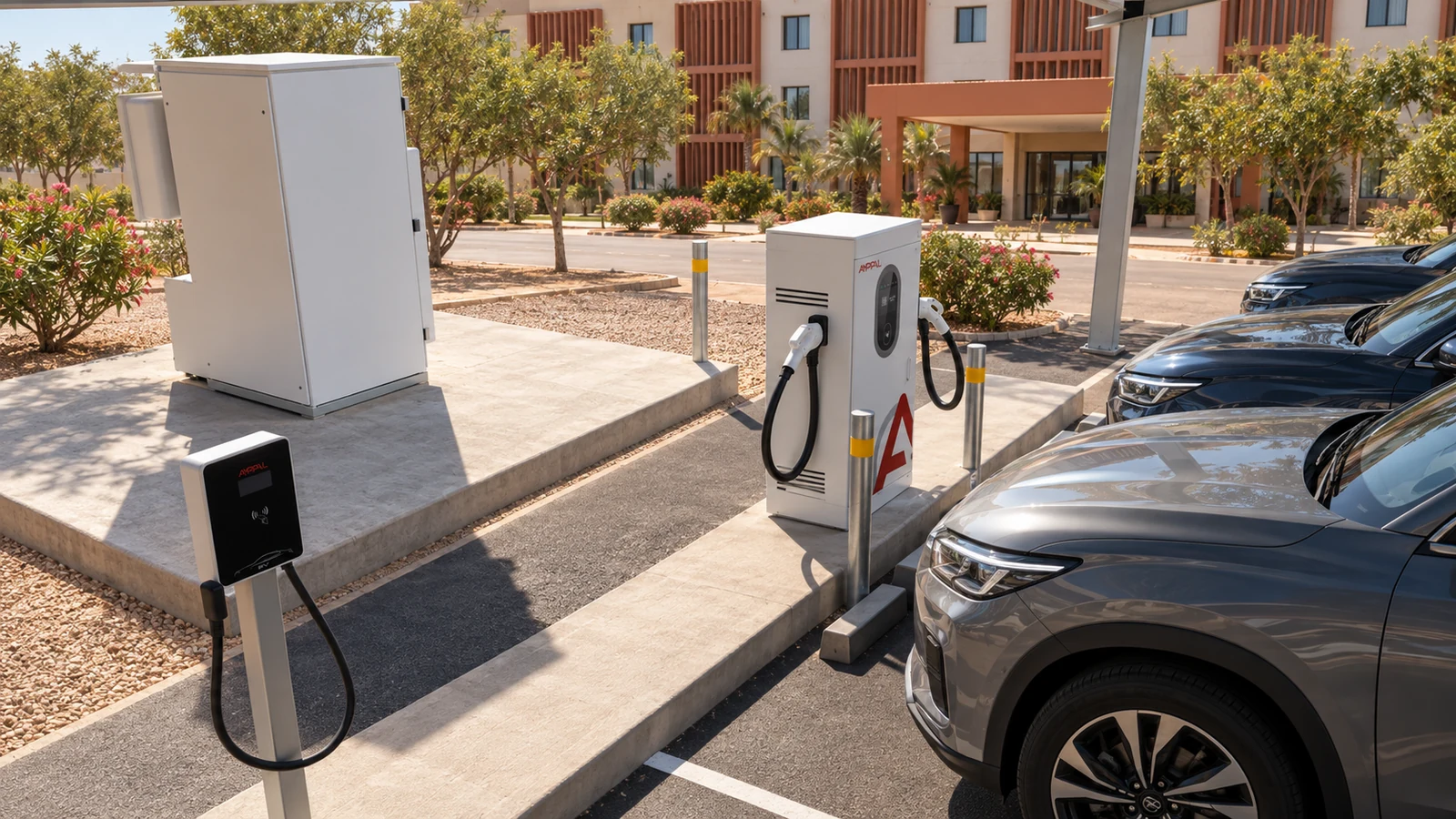
- DC fast charging — a 60 kW dual-gun DC charger with two CCS2 connectors, 200–1000 Vdc output and up to 200 A per session, so two vehicles can charge simultaneously. It supports OCPP 1.6J, RFID and QR-code access, and a 7” touchscreen, in an IP55 / IK10 enclosure.
- AC charging — eight wall-mounted 7 kW Type 2 chargers (32 A, IEC 62196-2) for longer parking sessions, each with OCPP 1.6J connectivity and Type A + 6 mA DC leakage detection.
Because the DC charger and the AC chargers share the same battery buffer, the site can serve a rapid-charge customer and several all-day parkers without ever exceeding its grid limit.
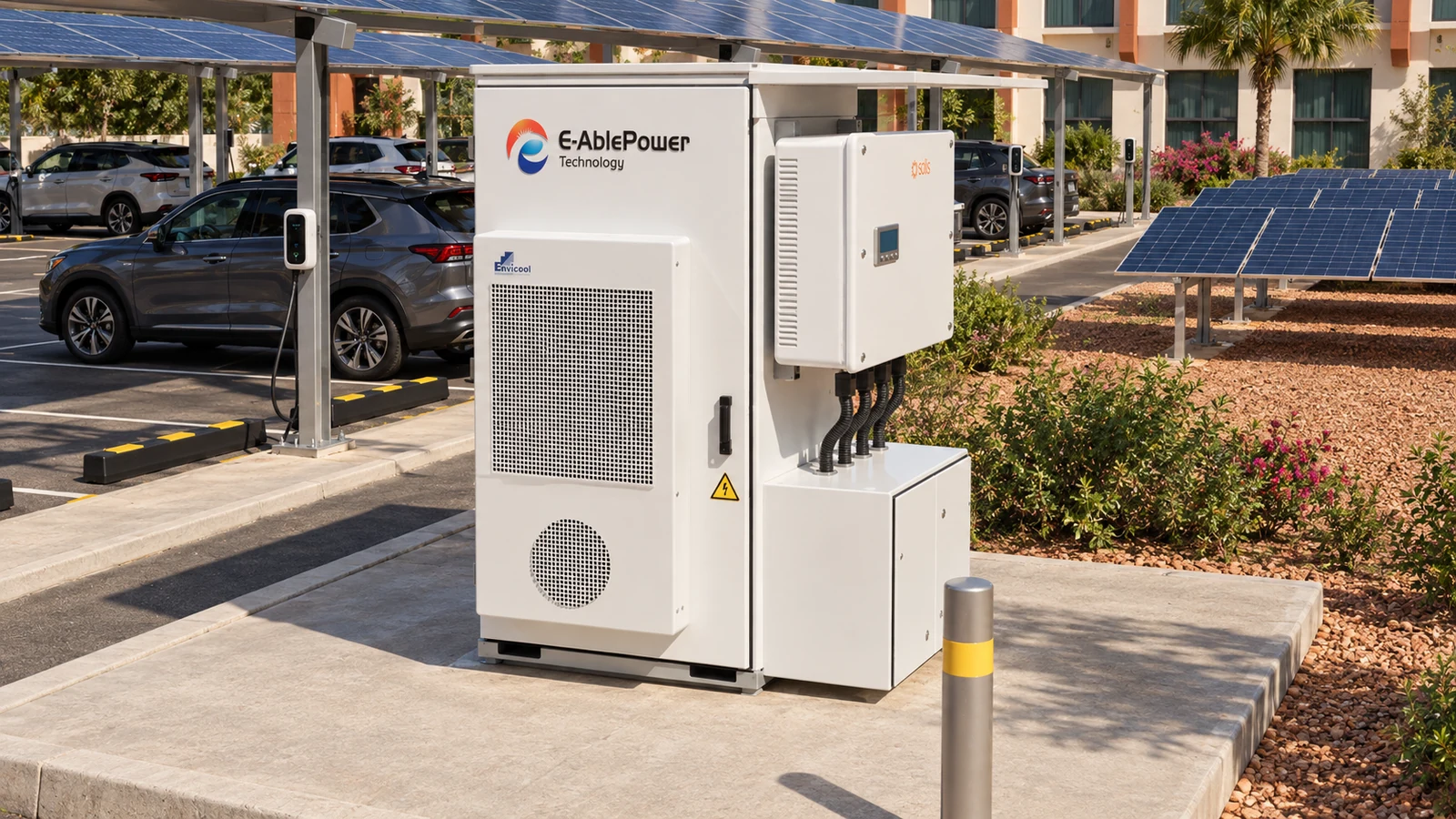
Sizing a solar carport: from a villa to a commercial centre
There is no single “correct” size — the right system depends on how many vehicles charge, how fast, and how strong the grid is. As a reference, these four configurations scale from a single-family villa to a busy commercial centre:
| Parameter | Compact Villa (AC) | Villa Dual (AC) | Hotel (DC Fast) | Commercial (DC Fast) |
|---|---|---|---|---|
| Photovoltaic | 12 kWp | 15 kWp | 72 kWp | 150 kWp |
| Storage | 30 kWh | 50 kWh | 120 kWh | 241 kWh |
| Inverter / PCS | 8 kW 3-phase | 20 kW 3-phase | 60 kW | 125 kW |
| EV charging | 1× AC 7 kW | 2× AC 7 kW | 1× DC 60 kW dual | 2× DC 60 kW dual |
| Simultaneous vehicles | 1 | 2 | 2 | 4 |
| Recommended use | Private villa | Large villa | 3–4★ hotel | Shopping centre / fleet |
As the table shows, storage and PV grow together with the charging power. A villa needs a few tens of kWh; a commercial centre needs a 241 kWh cabinet and a 125 kW inverter to keep four vehicles charging without stressing the grid. For sites that outgrow a cabinet, storage can be expanded with high-voltage stackable batteries and battery racks, or scaled to the megawatt level with utility-scale containers.
Deploying across five sites in West Africa
The reference project rolled this architecture out across five commercial sites. Each site receives a complete kit — a 241 kWh storage cabinet, a 125 kW hybrid inverter and a 60 kW dual-gun DC fast charger — supported by a solar carport array and ground-mounted panels that feed the same storage.
Standardising on one cabinet and one inverter across all five locations keeps spares, training and service identical from site to site. It also lets the operator monitor every station from a single dashboard, since each cabinet and inverter reports over RS485 / CAN and the chargers speak OCPP.
The benefits for the site owner
- Lower energy cost. Solar energy stored and delivered to vehicles reduces the electricity bought from the grid.
- Smaller grid connection. Peak shaving means the site does not need to pay for a connection sized to its worst-case charging peak.
- New revenue. DC fast charging becomes a service the site can sell, turning parking spaces into an income stream.
- Continuity. Backup mode keeps chargers and essential loads running through outages.
- Lower emissions. Every kilowatt-hour of solar charging displaces fossil-fuel generation.
Choosing the right C&I storage for EV charging
When specifying storage for a charging site, four questions matter most: how much energy is needed (kWh), how much power (kW), how fast it must respond, and how it will be serviced. E-Able Power's C&I range covers 50 kWh to 261 kWh per cabinet, with liquid-cooled and air-cooled options, and scales further with high-voltage stackable modules and stackable batteries.
You can explore the full line — cabinets, racks, containers and inverters — on our energy storage applications page, or send your site conditions for a sized proposal.
Why E-Able Power
E-Able Power manufactures and delivers complete solar and storage systems — residential batteries, C&I BESS cabinets, utility containers and hybrid inverters — from an ISO 9001 / ISO 14001 production base, backed by an overseas team providing local installation, training and after-sales service. For EV charging projects we supply the whole chain: PV, storage, conversion and chargers, sized together and delivered as one system.
Frequently asked questions
How much battery storage does an EV charging station need?
It depends on the charging power and the grid limit. As a rule of thumb, a 60 kW DC fast charger is best supported by 100–250 kWh of storage, so the battery can absorb solar and shave the charging peak. Our reference commercial sites use a 241 kWh cabinet per site.
Can a solar carport charge EVs at night?
Yes. Solar energy generated during the day is stored in the battery cabinet and released to the chargers after sunset, so charging continues on stored solar energy.
Does the system work if the grid fails?
Yes. With a hybrid inverter, the site switches to battery and solar power in under 10 ms, keeping chargers and essential loads running through an outage.
Can I start small and expand later?
Yes. The platform scales from a 50 kWh cabinet to multiple 241 kWh cabinets, and can be extended with high-voltage stackable batteries or utility-scale containers as demand grows.
Have a solar EV charging project?
Send your site conditions — number of vehicles, charging power and grid limit — for a system sized to your location, with layout, sizing and pricing within 2–3 business days.