
A solar street light is often specified by wattage, but wattage does not tell you how bright the road will be. Two luminaires with the same LED power can deliver very different lumen output depending on the chip, the optic and the driver. What the road receives is measured in lux, and the starting point for that is the lumen output of the fixture.
This guide explains how to translate a road brief into a lumen target, using the lumen bands of our own all-in-one, all-in-two and split ranges. It is a planning method, not a lighting design: the final layout still needs a DIALux simulation against the applicable road-lighting standard.
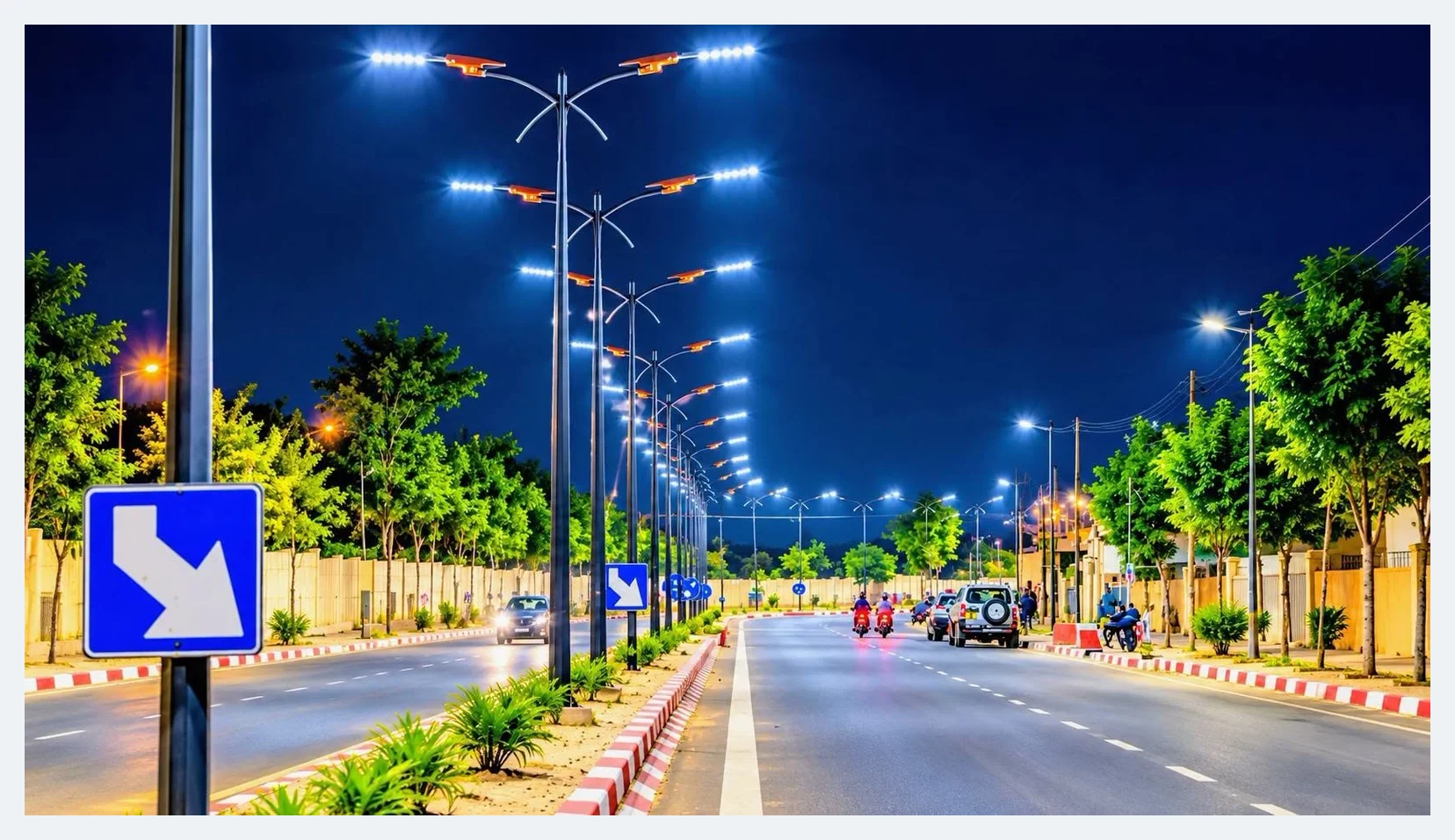
Lumens, lux and the road surface
Lumens (lm) describe the total light leaving a fixture. Lux (lx) describe how much of that light lands on one square metre of road. The same 10,000 lm fixture can produce a comfortable residential road or a dim, patchy one, depending on pole height, spacing, beam angle and the reflectivity of the surface.
That is why a lumen figure alone is not a specification. It is the input to a layout calculation. The calculation has to answer three questions: how wide is the road, how high is the pole, and how far apart are the poles.
The three inputs that decide lumen output
Road width. A wider carriageway needs more light to reach the far edge at the same illuminance. A 4 m path and a 14 m dual carriageway cannot use the same output or the same optic.
Pole height. Raising the pole spreads the light over a larger area, which lowers average illuminance unless output is increased. Taller poles also reduce glare and improve uniformity, so the answer is not to keep the pole low; it is to match output and optics to the height.
Pole spacing. Two poles 20 m apart overlap more than two poles 40 m apart. Wider spacing needs more output per pole, a narrower beam, or both. The spacing-to-height ratio is the quickest sanity check on a layout.
A useful first pass is to multiply the lit area between two poles by the target illuminance, then divide by a utilization factor that accounts for optics and losses. For a rough check, use 0.40–0.50. A DIALux model replaces that estimate with the real optic, mounting angle and road surface.
A lumen ladder from our own range
The table below groups our street-light models by lumen output. It is a starting point for matching a road class to a fixture family; it is not a claim that every road in that class needs exactly this output.
| Lumen band | Example models | Typical starting point |
|---|---|---|
| 2,400–4,000 lm | YL-30P, YY-80, YY-100 | Paths, residential lanes, campus walkways, 4–6 m poles |
| 6,000–10,000 lm | ST2-40, ST2-60; RS-SL120P, YH-120 | Residential collectors, industrial access roads, 6–8 m poles |
| 13,000–20,000 lm | ST2-80, ST2-100, ST2-160; RS-SL200P | Boulevards, dual carriageways, 8–10 m poles |
| 24,000–30,000 lm | ST2-210, ST2-260; Flyhorse-150 | Highways, interchanges, large squares, 10–12 m poles |
The bands overlap on purpose. A 10,000 lm fixture on a 6 m pole with tight spacing can light a collector road comfortably; the same fixture on a 12 m highway pole with 40 m spacing will not. The model family matters as much as the lumen number: an all-in-one unit integrates the panel and battery, an all-in-two separates the panel for more flexible aiming, and a split system puts the panel and battery on the ground or on a separate bracket.
Worked example: 9 m road, 7 m pole, 30 m spacing
Take a two-lane collector road 9 m wide, with 7 m poles and 30 m spacing. The project brief asks for 15 lux average, maintained. The lit area between two poles is 9 × 30 = 270 m². The lumens needed at the road are 270 × 15 = 4,050 lm. At a utilization factor of 0.45, the fixture output should be about 4,050 ÷ 0.45 = 9,000 lm.
That points to the 10,000 lm class: the Solara all-in-one or an equivalent all-in-two model. If the brief asks for 20 lux instead, the same calculation gives 270 × 20 ÷ 0.45 = 12,000 lm, which moves the starting point to the 13,000 lm class, such as the Luminara all-in-one.
The calculation is deliberately simple. It ignores the shape of the beam, the mounting angle, the road surface and the maintenance factor. Those are exactly the inputs a DIALux model adds. Use the arithmetic to shortlist a lumen class, then verify the layout before committing to a bill of materials.
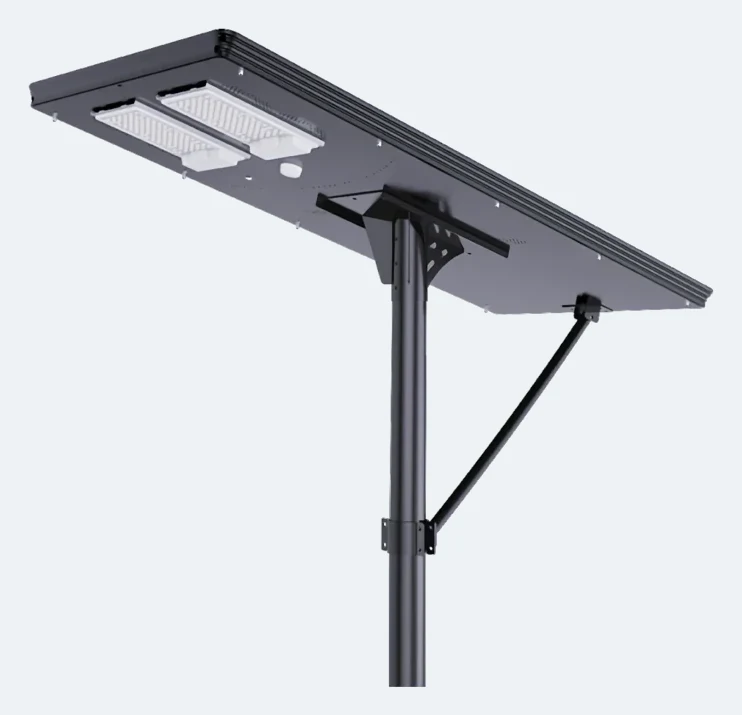
Why more lumens is not always better
Over-lighting a road wastes energy and can make the scene less comfortable. Too much light in the foreground compresses the pupil and makes the far road harder to read; a very bright fixture on a short pole also produces glare for drivers and residents. Uniformity matters as much as average lux: a bright pool under each pole with dark gaps between them is worse than a slightly lower but even distribution.
For a solar light, every extra lumen has to be paid for twice: once in LED power and once in panel and battery capacity. A 30,000 lm fixture needs a much larger array and battery than a 10,000 lm unit, which changes pole loading, shipping volume and foundation design. The right answer is the lowest output that meets the road brief with an acceptable uniformity and glare rating, not the highest number in the catalogue.
What reduces delivered lumens over time
Catalogue lumens are measured at a defined drive current and ambient condition. On site, delivered light falls because of dirt on the lens, LED depreciation, high cell temperature, and the dimming profile set in the controller. A maintenance factor of 0.70–0.80 is a common planning allowance for a well-maintained installation; dusty or coastal sites should use the lower end.
The controller also decides how much of the installed output you actually get through the night. A profile that runs 100% for the first hours and then dims to 30–60% with PIR boost delivers a different road appearance from a constant-output profile. Ask for the dimming schedule, not just the maximum lumen figure.
What to send for a lighting layout
A supplier cannot choose a lumen class from a road length alone. Send these six inputs and the layout can be modelled rather than guessed:
- Road width, number of lanes and whether there is a median.
- Pole height, mounting type and arm length.
- Pole spacing, or the spacing you want to achieve.
- Target average lux and uniformity, or the applicable standard.
- Site conditions: ambient temperature, dust, coastal exposure, wind.
- Quantity, project location and required delivery window.
If you already know the road class, the category pages for all-in-one solar street lights, all-in-two solar street lights and split solar street lights list the models and lumen outputs. For the relationship between pole height, spacing and road type, see our guide to the best height for solar street lights.
Frequently asked questions
How many lumens do I need for a solar street light?
It depends on road width, pole height and spacing. A path may need 2,400–4,000 lm, a residential collector 6,000–10,000 lm, a boulevard 13,000–20,000 lm, and a highway or interchange 24,000–30,000 lm. Use the calculation in this guide and confirm with a DIALux layout.
Is a higher-wattage solar street light always brighter?
No. Two fixtures with the same LED power can differ in lumen output because of chip efficiency, optic design and driver current. Compare lumen output and the delivered lux layout, not wattage alone.
What is a good lumen per watt figure for a solar street light?
Our all-in-one range spans roughly 110–165 lm/W at the LED module level, depending on the model and drive current. A higher figure helps battery and panel sizing, but the optic and uniformity still decide whether the road is lit well.
Can I use a 30,000 lm light on a 6 m pole?
You can, but it will usually produce glare and an uneven pool of light. High-output fixtures are intended for taller poles and wider roads. Match the output to the mounting height and spacing, or the extra lumens become discomfort and wasted energy.
How much does dirt reduce solar street light output?
Dirt, LED depreciation and high temperature can remove 20–30% of the initial output over time. A maintenance factor of 0.70–0.80 is a common planning allowance; dusty, coastal or high-pollution sites should use the lower end and plan a cleaning schedule.
Turn your road brief into a lighting layout
Send road width, pole height, spacing and target lux. We will return a lumen class, a DIALux layout and a quotation.