
Vertical PV is rarely chosen for yield. It is chosen because the structure is already there: a lighting pole, a boundary wall, a roof parapet. That moves the first decision from the module to the mounting position, because a pole clamp, a wall anchor and a parapet bracket load three different parts of a building.
This guide compares the three positions on what carries the load, what the wind sees, how the glass is cleaned and where the cable runs. Every module figure comes from our SolarWrap pages.
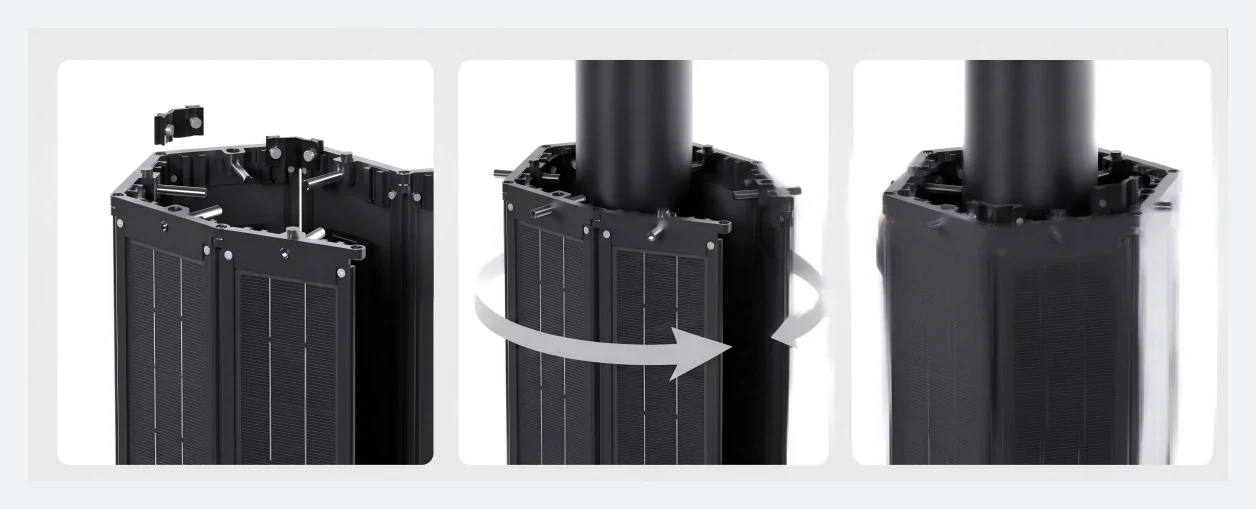
The position decides four things
- What carries the module. A pole carries it through two or three clamps. A wall, through anchors into the substrate. A parapet, through brackets pushing sideways into a wall that may have been designed for edge protection only.
- What the wind sees. Wind load acts on the frontal silhouette. A round tube presents the same narrow profile from every direction; a flat or square module shows its full width to one direction.
- How the glass gets cleaned. Vertical glass sheds most dust and snow, but coastal salt and construction dust still need a wash — and a module nobody can reach stays dirty.
- Where the cable goes. Inside the pole, in UV-rated conduit, or clipped along a wall, always with a drip loop at the gland.
Three positions, three load paths
| Position | Carries the module | Wind silhouette | Access | Fails first |
|---|---|---|---|---|
| Pole, 3–12 m | Two or three clamps on the mast | Narrow if round | Ladder or platform | Clamp crushing a thin pole wall |
| Wall or fence | Anchors into the substrate | Full module width | Usually from ground | Anchor pull-out; a fence panel was never structural |
| Roof edge or parapet | Brackets into parapet or slab | Full width, at height | Roof access only | Lateral load on a parapet built for edge protection |
Pole: the clamp is the specification
On a pole the module is not bolted to a frame; it is clamped to the mast, and the mast carries everything. That makes clamp spacing and pole wall thickness the design variables. A module specified for a 4 mm wall pole must not go onto a 2.5 mm one because the bracket happens to fit — the clamp load has to be carried at the mounting height.
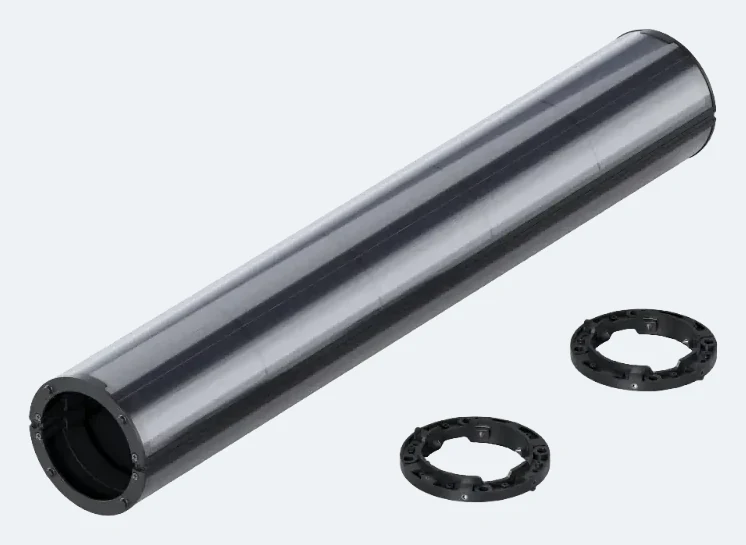
The format follows the pole, not the wattage. The tube is the default for street lighting: the S80, S100 and S140 tube modules wrap the mast, look the same from every direction and remove the orientation decision — 80 W to 140 W, poles from 60 mm to 170 mm, 22.5 % efficiency, IP66.
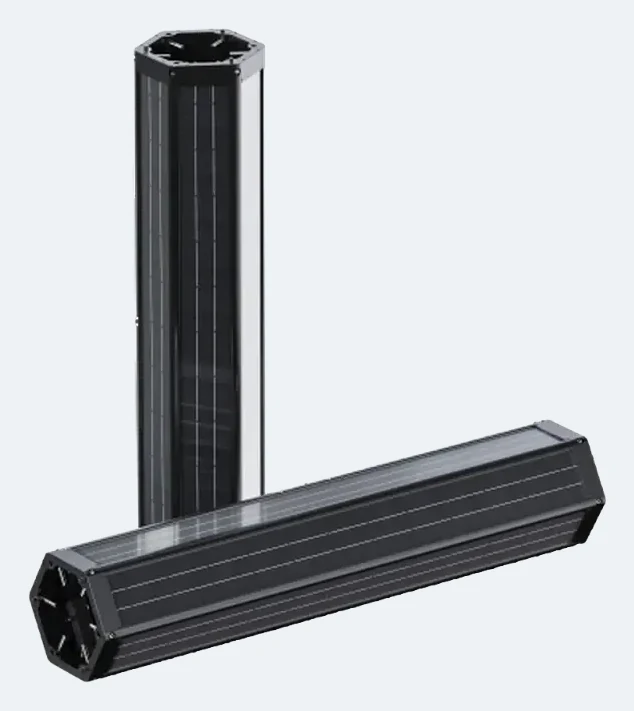
For more power in the same height, the hexagonal Q140 and Q200 pole-clamped modules put six PV faces on one slim cylinder: 140 W at 1,560 mm, 200 W at 2,060 mm, poles up to 150 mm, IP66 and IK08, 5-year warranty. The square section goes further — the SQ260 carries 260 W in one 220 mm module on poles up to 140 mm — because four flat faces hold more glass per metre.
Above 260 mm the rigid formats run out of range and the GeoFlex foldable modules take over: 100 W to 300 W, hexagon to dodecagon, poles to 330 mm, shipped flat at less than half the freight volume of a rigid cylinder. The pole can be specified with them: the CIRCULAR solar pole is hot-dip galvanised Q235B (stainless optional), 3 m to 12 m, compatible with Q140, Q200 and the OCTA series, rated to 160 km/h on a project-specific foundation design — a rating that belongs to a calculation, not a catalogue line.
Wall and fence: an anchor is not a clamp
Our published range is pole-clamped, which is an honest limit rather than a gap. A wall replaces the clamp with an anchor, and an anchor is a calculation about the substrate: solid masonry, hollow block, a steel fence post and a precast panel behave differently under pull-out and shear. A fence panel is not a structural member.
Two details decide whether it lasts: clearance behind the glass, because a bifacial rear face earns nothing clamped flat against a wall, and a cable route in UV-rated conduit with a drip loop, because a wall route is exposed for its whole length. If the wall is the only option, send the section and the substrate; the anchor design stays with an engineer who has seen the wall.
Roof edge and parapet: the roof is not the structure
A vertical row on a parapet needs no ballast on the membrane and keeps the walkway clear. What it needs is a parapet that can take lateral load at bracket height. Many parapets are designed as edge protection, and edge protection resists a person, not a row of glass in a gale.
Check the as-built section and reinforcement, whether the bracket can reach the slab or a steel member behind the parapet, and how the waterproofing terminates at each fixing. If the parapet cannot take the load, the row moves onto a steel frame anchored to the slab — a change of silhouette and cost that belongs in the quotation.
What vertical does to the daily curve
A vertical module gives up its peak at solar noon, when the sun is high and the incidence angle is poor, and loses least morning and afternoon. That flatter curve often suits a battery charged by day and discharged at night better than a peak it cannot absorb. High latitudes with a low winter sun gain most, as do dusty or snowy sites where a tilted array would produce nothing for part of the year. The pole-mounted vertical PV selection guide covers the format comparison in full.
Worked example: 8 m pole, 80 W head
Our hexagon page publishes a typical configuration for a 60–80 W LED head on a 7–8 m pole: Q200 × 2 at 24 V with a 538–768 Wh LiFePO4 battery. Take the larger battery, an 80 W head running 11 hours, and two stated assumptions — 3.5 equivalent sun hours on the vertical plane and a 0.8 system factor. Both are placeholders for your own irradiance data.
| Input | Value | Source |
|---|---|---|
| Array | 2 × 200 W = 400 Wp | Q200 page |
| Battery | 768 Wh | Q200 typical installation |
| Night load | 80 W × 11 h = 880 Wh | Assumption |
| Daily harvest | 400 × 3.5 × 0.8 = 1,120 Wh | Assumption |
The array covers the night at 1.27 times the load, and the battery holds 0.87 of one night alone — the number to watch, because on a run of poor days the battery empties before the array is the problem. At 2.5 equivalent sun hours the harvest falls to 800 Wh, 80 Wh short every day.
Glass per square metre of wind area
Because the bracket carries the frontal silhouette, formats compare best on power per square metre of published envelope — an upper bound, since a polygon presents less than its bounding box.
| Model | Power | Envelope m² | W/m² |
|---|---|---|---|
| S140 | 140 W | 0.250 | 561 |
| SQ220 | 220 W | 0.339 | 649 |
| Q200 | 200 W | 0.470 | 426 |
| DODE-30036 | 300 W | 0.663 | 452 |
The square section wins on density, the tube on a narrow silhouette, the foldable dodecagon on pole diameter and freight. None wins on all three.
What to send before we quote
- The pole drawing, or the wall and parapet section: diameter at both clamp heights, wall thickness, material, and the substrate.
- The load: head wattage, operating hours, and whether the light dims after midnight.
- The site: latitude, dust or snow, coastal salt, design wind speed.
- Who owns the anchor or foundation design, so neither side assumes the other has it.
- Whether the module must be removable for cleaning without a platform.
With those answers the position, format and clamp set fall out in one pass. The SolarWrap vertical panel range lists every format with its pole range, the step-by-step pole installation guide covers the site sequence, and the wind-resistance test report shows what the modules were put through. Send the drawing through the contact page.
Frequently asked questions
Can a SolarWrap module go on a wall instead of a pole?
The published range is pole-clamped, with clamp rings sized to a diameter range. A wall needs a bracket and an anchor calculation for that substrate, and that design belongs to an engineer who has seen the wall.
Which format fits an existing 100 mm pole?
A circular S100 covers 70–120 mm and the square SQ140 or SQ220 covers up to 120 mm. The tube needs no orientation decision, so it is the faster retrofit; the square gives more power in the same height.
Does a vertical module remove the structural check?
No. A round tube is narrow from every direction, but a flat or square module still presents full width to one wind direction. Ask for the projected area used in the calculation.
What warranty applies?
Three years on the circular and GeoFlex series, five years on the hexagon and square series, as published on each product page. Terms are confirmed per product in the quotation.
Confirm the mounting before the model
Send the pole drawing, or the wall and parapet section, with the load and the site conditions. We will confirm the format, the clamp set and the battery size before quotation.