
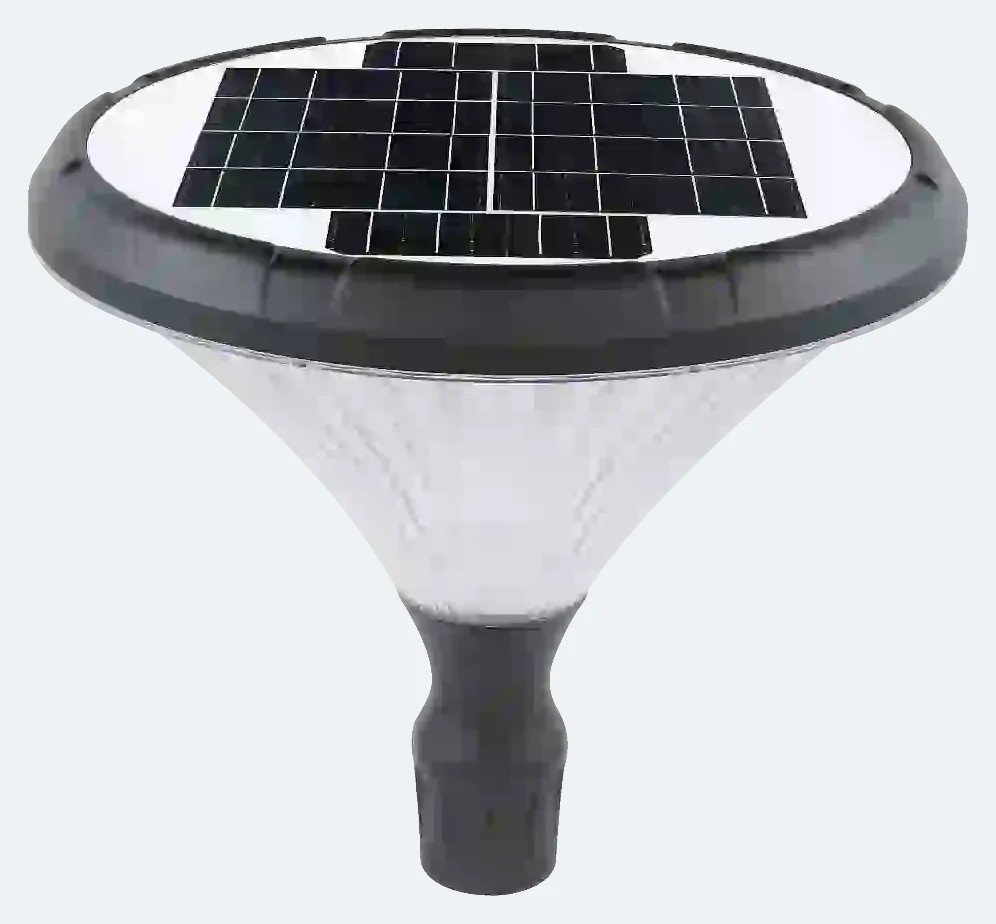
A post-top light sits directly on the pole: the solar panel is laminated into the crown, the battery and controller sit beneath it, and the head drops onto a spigot. No trenching, no cable back to a cabinet. Panel on the fixture, not on a separate bracket, sets the rules for the category.
This guide compares the two E-ABLE POWER families, GGD and TYD, across the 29 models on the solar post-top category page: what the format fixes, which published numbers separate the models, and the arithmetic that narrows a choice.
What the post-top format fixes
On a post-top fixture the array lies flat on the crown, with no seasonal tilt and no separate frame, so array area is capped by head diameter — 400 mm on the compact square models, 1,660 mm on the widest bar.
The pole does two jobs: it sets the height of the light and the height of the array. Raising it clears the panel of hedges and cars but also raises the luminaire, which changes the spread of light and the glare seen from a window. Shading is fixed by moving the pole, not by tilting the panel — and because every pole is independent, a scheme is sized pole by pole.
GGD and TYD: what actually separates them
Both families share the same construction: die-cast aluminium, PC or tempered-glass diffuser, IP65, 3000–6500 K, dusk-to-dawn control, 3.2 V LiFePO4. The differences are scale and beam shape.
GGD is the lantern-shaped group: 9–28 W panels, 12,000 mAh to 30 Ah batteries, 778–1,735 lm, mostly 360° or 180°. Two are complete post fixtures rather than heads: the ZC-GGD3608 at 1.0–2.6 m, and the ZC-GGD4505 at 2.6 m with two or three heads.
TYD is the same shapes at larger scale: 20–62 W panels, up to 100 Ah (320 Wh), up to 8,303 lm, with 360°, 180°, 120° and 90° beams. The 42-series uses tempered glass, which matters where grit and salt are in the air.
GGD is courtyard and entrance scale; TYD is plaza and roadway scale. Eight representative models:
| Model | Form | Panel | Battery | Flux | Beam | Head size |
|---|---|---|---|---|---|---|
| GGD-001 | Round lantern | 20 W | 20 Ah (64 Wh) | 822 lm | 360° | 480 × H440 mm |
| GGD-003 | Round lantern | 25 W | 30 Ah (96 Wh) | 1,735 lm | 360° | 530 × H490 mm |
| GGD-2005 | Wide round | 28 W | 30 Ah (96 Wh) | 1,378 lm | 360° | 1,070 × H300 mm |
| TYD-2403 | Square | 20 W | 20 Ah (64 Wh) | 1,163 lm | 360° | 400 × 400 × H420 mm |
| TYD-2505 | Square, low profile | 48 W | 60 Ah (192 Wh) | 3,539 lm | 360° | 580 × 580 × H255 mm |
| TYD-2609 | Round | 36 W | 45 Ah (144 Wh) | 2,650 lm | 180° | φ585 × H550 mm |
| TYD-4208 | Square, tempered glass | 62 W | 100 Ah (320 Wh) | 5,105–5,740 lm | 90° | 590 × 590 × H505 mm |
| TYD-5105 | Wide bar | 52.5 W (18 V) | 60 Ah (192 Wh) | 7,896–8,303 lm | 180° | 1,660 × H435 mm |
The battery is always 3.2 V, so amp-hours become watt-hours by multiplying by 3.2: 30 Ah is 96 Wh, 100 Ah is 320 Wh. Flux does not track head size — the 1,070 mm GGD-2005 publishes 1,378 lm, the 400 mm TYD-2403 1,163 lm, under 20% apart for heads that differ 2.7 times. Head size is about distribution and wind load, not output.
Three numbers worth comparing, and one ratio
Panel watts set the recharge rate, watt-hours the night reserve, and flux the output — but only at a stated colour temperature: the TYD-4208 reads 5,105 lm on PWM control and 5,740 lm on MPPT at 6500 K; the TYD-2505 reads 3,539 lm at 3000 K against 3,636 lm at 6500 K.
The ratio that predicts behaviour is watt-hours divided by panel watts — the hours of full panel output the battery can store:
- GGD-001: 64 Wh ÷ 20 W = 3.2 h
- GGD-003: 96 Wh ÷ 25 W = 3.8 h
- TYD-2505: 192 Wh ÷ 48 W = 4.0 h
- TYD-2609: 144 Wh ÷ 36 W = 4.0 h
- TYD-4208: 320 Wh ÷ 62 W = 5.2 h
A low ratio recharges fast with little reserve; a high ratio holds more nights but needs more sun.
Beam angle decides where the pole goes
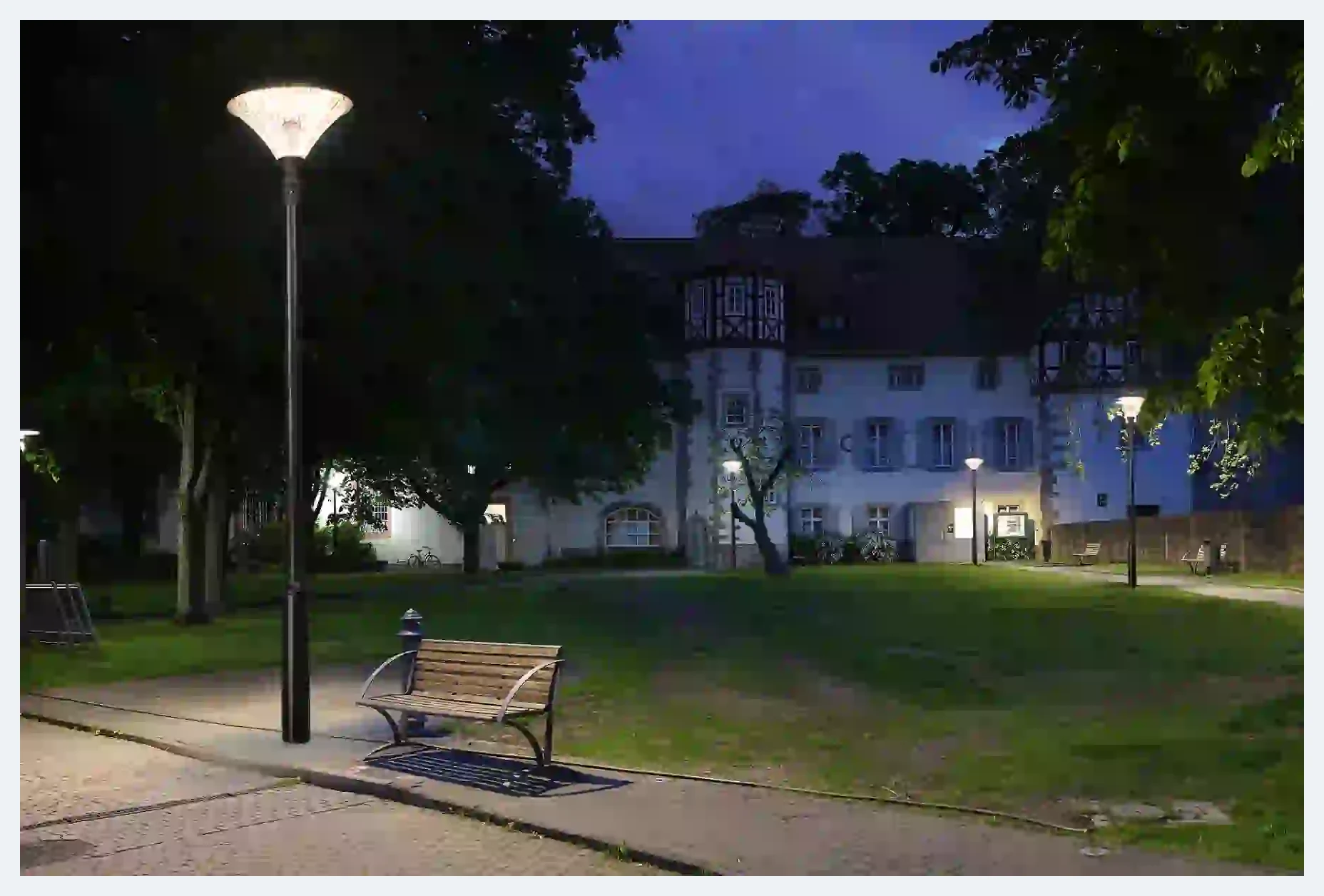
Beam angle is usually decided late and is the most expensive to correct. A 360° head belongs on a pole standing in the middle of what it lights: plaza, courtyard, roundabout, centre line of a wide walkway. A 180° head belongs on the edge, throwing light across a path or along a facade. A 90° or 120° head throws further in one direction, for a lane where the poles are set back from the kerb.
A 360° head on the edge of a path throws half its output into the planting.
It is published per model, not per family: the TYD-4206 is 120° and the TYD-4208 90°, from the same tempered-glass family.
A worked example: a 120 m promenade
120 m promenade, poles at 8 m centres: 15 bays, 16 poles. Scheme A, 16 GGD-003 heads — 400 W of array, 1,536 Wh of storage, 27,760 lm. Scheme B, 16 TYD-4208 heads — 992 W, 5,120 Wh, 91,840 lm on MPPT at 6500 K.
They answer different briefs: A is a courtyard-scale path with a 360° head, B a taller pole line with the 90° beam down the lane. The step between them is 2.5 times the array, 3.3 times the storage and 3.3 times the output for the same poles.
Now the recharge check, because the published 3–5 hour charge time is a full-sun figure. At 4 peak-sun hours and 80% charge efficiency:
- GGD-003: 25 W × 4 h × 0.80 = 80 Wh per day against 96 Wh, about 1.2 days to refill from empty.
- TYD-4208: 62 W × 4 h × 0.80 = 198 Wh per day against 320 Wh, about 1.6 days.
- TYD-5105: 52.5 W × 4 h × 0.80 = 168 Wh per day against 192 Wh, about 1.1 days.
Hold those against the published 3–5 rainy-day autonomy: holding three nights is not the same as refilling in one day, and a monsoon site needs both numbers.
What to send for a model recommendation
A model can be narrowed from a site plan that carries the data:
- Pole height and spigot diameter. The ZC-TYD2505 architectural variant is published for a 76 mm post.
- Pole spacing and the width of the lit surface.
- Target illuminance, or the standard the scheme must meet.
- Peak-sun hours per day, and the worst month rather than the annual average.
- Mounting surface — soil, concrete or roof deck — and the design wind speed.
- Colour temperature, quantity and delivery schedule.
If you are replacing heads on existing poles, add the top diameter and a photograph: the head is the only part that changes, and a mismatched spigot is the usual cause of a delay.
The full range is on the solar post-top lights category page; the GGD-001, GGD-003, TYD-2403, TYD-2505, TYD-4208 and TYD-5105 pages carry these specifications. For panel cleaning and battery care, see the post-top installation guide; for a roadway rather than a path, the guide to mounting height and spacing covers the arithmetic before a head is chosen. Send the layout through the project support page for a model recommendation and a DIALux check.
Frequently asked questions
What is the main difference between a GGD and a TYD post-top light?
Scale and beam choice. GGD heads run from 9 W to 28 W of panel and 38 to 96 Wh of battery, in lantern shapes up to 1,070 mm wide. TYD heads run from 20 W to 62 W and up to 320 Wh, reach 8,303 lm, and offer 90°, 120°, 180° and 360° beams. Housing, IP65 rating and colour temperature range are the same.
How many lumens do I need for a 3 m pole?
There is no single number: it depends on spacing, lit width and target illuminance. What can be calculated is the total — required lux times lit area, divided by a utilisation factor. Split that across the poles and compare with each model's published flux; we run the check in DIALux on the layout.
Can a post-top head be fitted to an existing pole?
Often, yes, if the spigot diameter and pole-top fixing match. The head is supplied for pole-top mounting; the pole is by the installer unless ordered with the fixture. Send the top diameter and a photograph and the factory will confirm the adapter.
Is IP65 enough for a coastal site?
IP65 covers dust and water jets, not salt corrosion. Ask for the coating specification and the housing alloy, and expect more frequent cleaning of panel and housing. Salt spray is a maintenance question, not an ingress question.
Why is the flux different for 3000 K and 6500 K?
The two are measured at different operating points of the same LED array. Compare like with like — 3000 K against 3000 K, PWM against PWM. Mixing them is the most common way a comparison table flatters the wrong model.
Narrow the model against your layout
Send the pole height, spacing, spigot diameter, target illuminance and worst-month sun hours. We will return a model recommendation, a DIALux check and a quotation.