
A split solar street light is four products on one pole: a luminaire head, a PV panel on its own bracket, a battery in its own enclosure and an MPPT controller. Because the parts are separate, the sizing question changes. The wattage is the last thing to fix, not the first.
What fixes it is the road section — carriageway width, lane count, where the pole line can stand, and whether one arm or two leaves the pole. This guide maps the seven published configurations to that section, then runs the energy arithmetic on one of them so you can see where an 8 m, 60 W pole stops being enough.
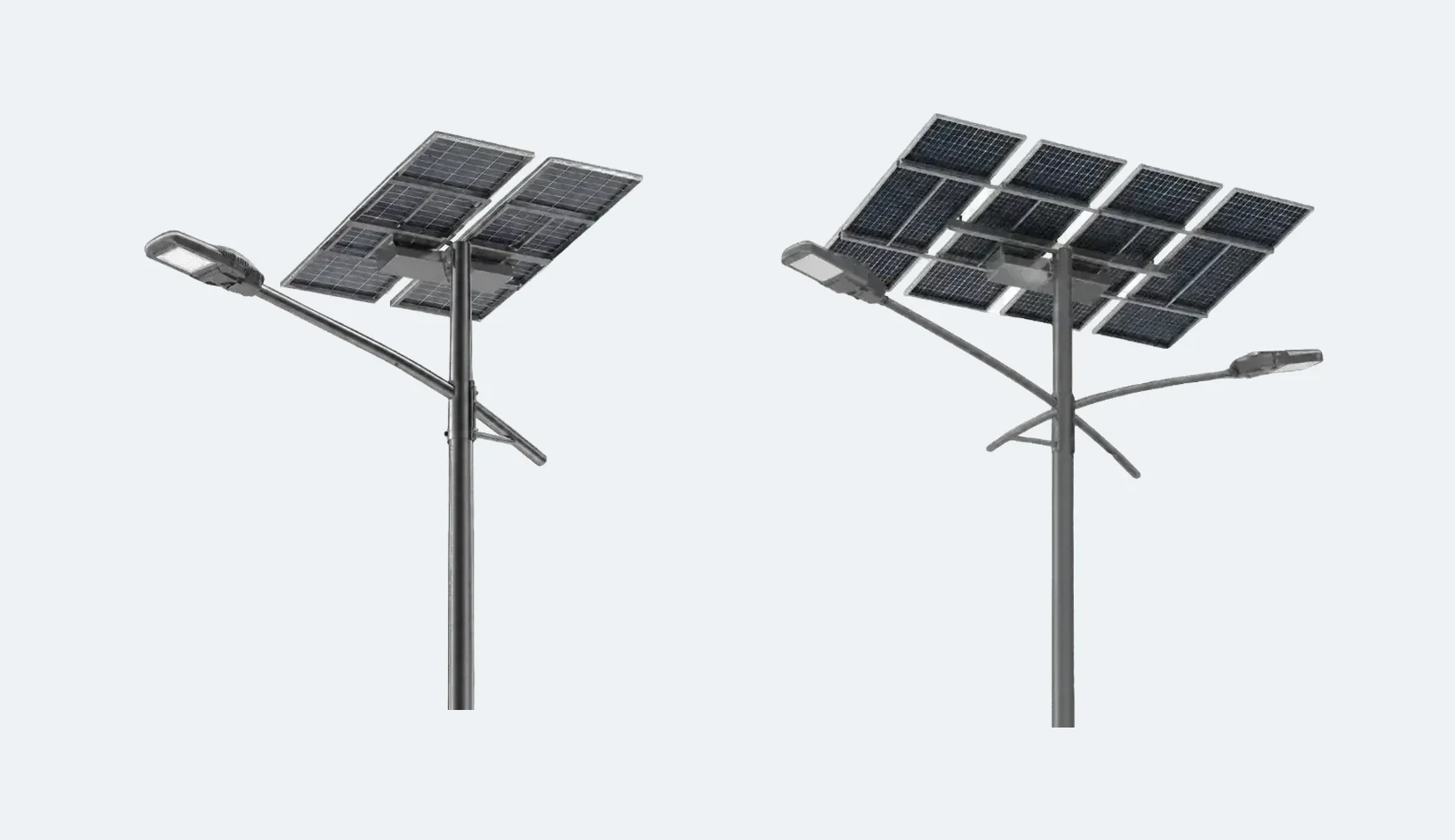
Height sets the reach, not the wattage
Every model in the range is published at one mounting height: 50 W at 7 m, 60 W at 8 m, 80 W at 9 m, 100 W at 10 m. The pairing is not marketing. A head's throw, its glare and the area it covers all scale with height, so a 100 W luminaire on a 7 m pole does not light more road — it lights the near kerb harder and puts more glare into the eyes of anyone coming the other way.
As a planning rule we start a single-arm row when the carriageway is no wider than the mounting height, and look at a second row or a double-arm pole when it is wider. That rule is arithmetic for a first pass, not a lighting class. Final illuminance, uniformity and glare come from a photometric study against the standard that applies where you build.
Four inputs decide the model
| Input | What it decides | Where projects go wrong |
|---|---|---|
| Carriageway width and lane count | Single or double arm, and the height band | Width measured at the narrowest point instead of the section being lit |
| Pole line position and overhang | Arm type and reach | Assuming the verge is free and the kerb can take a foundation |
| Target illuminance and uniformity | Head wattage and optic | A lux target copied from another city's standard |
| Nightly hours and autonomy days | Panel and battery, separately | Sizing the head and leaving the rest on default |
The published range in one table
| Configuration | Head | Pole / arm | PV | Battery, per head | PV / head |
|---|---|---|---|---|---|
| 50 W single | 50 W, 170 lm/W reference | 7 m single | 100 W mono | 12.8 V 50 Ah LiFePO4 | 2.0× |
| 60 W single | 60 W, 170 lm/W reference | 8 m single | 120 W mono | 12.8 V 60 Ah LiFePO4 | 2.0× |
| 80 W single | 80 W SMD | 9 m single | Mono, project-sized | LiFePO4, 4,000+ cycles | — |
| 100 W single | 100 W SMD, >15,000 lm system | 10 m single | 200 W mono | LiFePO4, 4,000+ cycles | 2.0× |
| 2 × 50 W double | 2 × 50 W, 170 lm/W reference | 7 m double | 2 × 100 W mono | 2 × 12.8 V 50 Ah | 2.0× |
| 2 × 60 W double | 2 × 60 W, 170 lm/W reference | 8 m double | 2 × 120 W mono | 2 × 12.8 V 60 Ah | 2.0× |
| 2 × 80 W double | 2 × 80 W, 170 lm/W reference | 9 m double | 2 × 150 W mono | 2 × 12.8 V 80 Ah | 1.9× |
Two patterns run through the table. The PV array is about twice the head wattage everywhere it is published — 100 W of panel behind a 50 W head, 200 W behind 100 W, 2 × 150 W behind 2 × 80 W. And every head carries its own controller, which on a double-arm pole means two independent strings: a failed battery takes out one side, not the street.
One caution on the battery column: cycle life is published as 4,000+ cycles on the 80 W and 100 W single-arm pages and 2,000+ on the double-arm pages, because they are different packs. Confirm the cell and the cycle figure per battery in the quotation.
Single arm or double arm
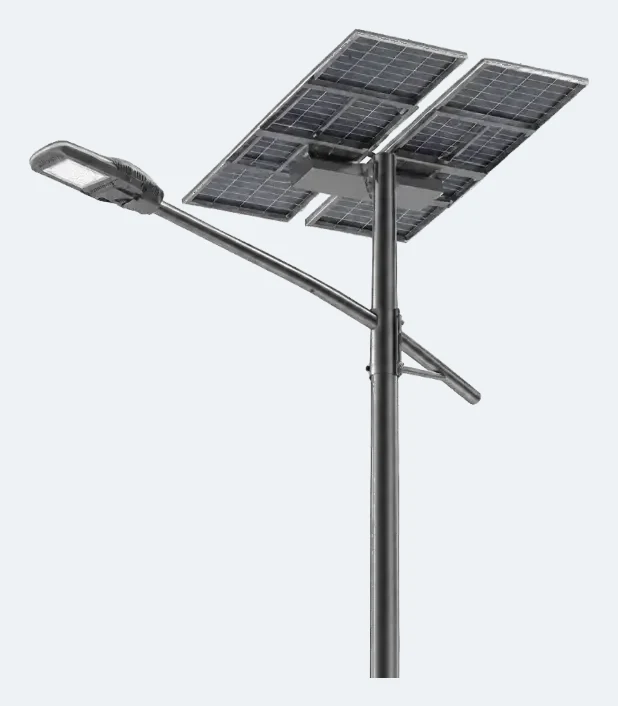
Single arm is the default because it is the cheaper pole, the simpler foundation and the easier cable route: one row of poles on one verge, heads reaching across the carriageway.
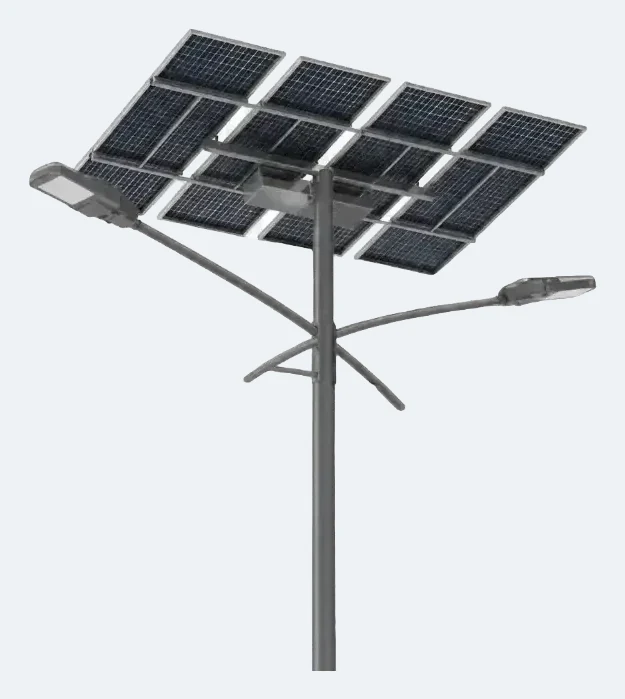
Double arm earns its place in two situations. The first is a pole line on a median or a centreline, where both carriageways have to be lit from the same pole. The second is a street where the far verge cannot take poles at all — walls, driveways, buried services. The published double-arm versions carry two identical heads at 7 m, 8 m or 9 m with a panel, battery and controller per head, so the two sides stay independent.
The 7 m double-arm split light suits a two-way town street where one row of poles sits on the centreline; the 9 m double-arm 80 W version is the one for a wider municipal road with two full lanes on each side.
Worked example: the 8 m, 60 W pole
The 60 W page publishes a 120 W panel, a 12.8 V 60 Ah battery — 768 Wh — and a 170 lm/W reference efficacy. Take two operating profiles: eight hours with the last three dimmed to half, and eleven hours with the last six dimmed to half.
| Item | 8 h profile | 11 h profile |
|---|---|---|
| Night load (5 h full, remainder at 50 %) | 390 Wh | 480 Wh |
| Battery energy, 12.8 V × 60 Ah | 768 Wh | 768 Wh |
| Nights on battery alone | 1.97 | 1.60 |
| Harvest at 4.2 peak sun hours, 0.75 system factor | 378 Wh | 378 Wh |
| Harvest ÷ load | 0.97 | 0.79 |
At eight hours the reference configuration is balanced: the array covers 97 % of the night and the battery holds almost two nights if the weather turns. At eleven hours it is 102 Wh short every night, and the shortfall compounds — after three poor days the battery is empty before the array becomes the problem. The fix sits upstream of the battery: a 160 W panel returns 504 Wh at the same site, and a site with 5.4 peak sun hours closes the gap on the 120 W panel.
Both sun numbers are placeholders. 4.2 peak sun hours and a 0.75 system factor are temperate defaults; your site data replaces them. What does not change is the order of the check: head first, because the road decides it; panel second, because the sun decides it; battery third, because autonomy is a number you choose and then pay for.
When the road is wider than 100 W can hold
Past a 10 m single-arm pole the range hands over to the RadiantSun split light at 150–200 W for multi-lane highways, ports and high-latitude sites, or to a double-arm pole if the pole line allows it. Past that, the honest answer is a different family — high mast for very wide industrial aprons, or a grid-connected LED row where power is available.
What to send before we quote
- The road section: carriageway width, lane count, kerb to kerb, and where the pole line can stand.
- The lighting target: average lux and uniformity from the local standard, or the nearest comparable scheme.
- Operating hours, the dimming schedule after midnight, and how many consecutive poor days the street must ride through.
- Site data: latitude, monthly peak sun hours if you have them, wind zone, coastal or dusty exposure.
- Quantity, pole material preference, and who owns the foundation design.
With those answers the model and the panel fall out in one pass. The split solar street light range lists every configuration with its datasheet; the lumens selection guide explains why a 170 lm/W head and a 150 lm/W head of the same wattage are not the same lamp; the pole height and spacing guide covers the geometry. Send the road drawing through the contact page and we return a configuration with the photometric check.
Frequently asked questions
Can I keep the pole and change only the head?
Often yes, because the four parts are separate — but the panel and battery have to be re-sized with the new head, and the pole's wall thickness and clamp arrangement have to carry it. Send the pole drawing with the enquiry.
How many cloudy nights will it ride through?
Published autonomy is 3–4 overcast nights on the 80 W and 100 W models. On the 50 W and 60 W reference packs our arithmetic gives about two nights at an eight-hour dimmed profile. State the number your road needs and the battery is sized to it.
Does the panel have to face south?
South in the northern hemisphere, north in the southern. The split layout lets the panel be aimed independently of the arm, which is the reason to choose split on a street where the pole line runs east–west.
What is the difference between split and all-in-one?
All-in-one puts panel, battery and controller in the head; split separates them. Split allows a larger panel and battery and a separately aimed array, at the cost of more visible components and more cable between them.
Send the road section, get the model
Carriageway width, lane count, pole line position and the autonomy you need are enough for a first configuration. We return the model, the panel and the battery together, with the photometric check named.