
Solar street light technology is converging on one key question: should the solar panel lie flat on top of the pole, or wrap around it? For most of the industry's history, the flat panel won by default — it was the only option. But vertical cylindrical solar panels — commonly called Solar Wrap or pole-mounted solar modules — have changed the calculation. This guide compares both designs across wind resistance, charging performance, installation, and lifecycle cost, so you can specify the right system for your project.
What Is a Solar Wrap Street Light?
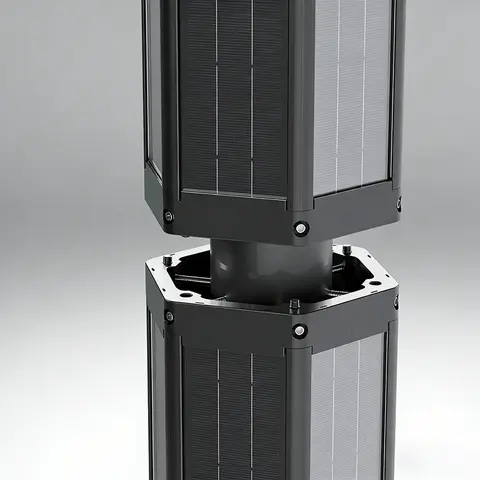
A Solar Wrap street light replaces the traditional flat photovoltaic panel with curved cylindrical, hexagonal, or multi-facet solar modules that wrap around the pole itself. The pole becomes the solar collector. The lamp head mounts above or below the wrapped section, and the entire structure presents a clean, architectural silhouette.
Wind Resistance: The Decisive Difference
The single most important engineering difference is wind load .
Flat panels act as sails. A large flat panel mounted on a pole presents maximum frontal area to the wind. In coastal regions, high-plateau sites, and cyclone zones, wind load is the #1 cause of solar street light failure — bent poles, cracked mounting brackets, and panels torn from their frames.
Vertical panels minimize frontal area. A cylindrical or hexagonal module presents a minimal profile to wind from any direction. E-Able Power subjects its hexagonal Solar Wrap pylons to industrial wind-load simulation , and the wrapped design dramatically reduces structural stress compared with an equivalent flat panel.
For projects in typhoon belts (Southeast Asia, the Caribbean, coastal Africa) or high-altitude plains, vertical solar panels are the structurally safer specification .
Charging Performance: 360-Degree Light Capture
A flat panel is fixed at one angle. It harvests well only when the sun is in the right sector of the sky.
A vertical wrap panel collects sunlight from every direction :
Morning — east-facing segments charge while a flat panel is still in shadow.
Midday — overhead sun still strikes the upper wrap segments.
Afternoon — west-facing segments capture late sun.
Overcast conditions — scattered light is absorbed across all faces, not just one plane.
The practical result: longer effective charging hours per day and more consistent energy yield in hazy, dusty, or low-angle-sun environments — a real advantage near the equator and in regions with heavy atmospheric haze.
Comparison Table: Vertical vs Flat Panel Street Lights
When to Choose Each Design
Choose a flat-panel system when:
The site is inland with low wind exposure and reliable direct sun.
You need maximum panel wattage in a minimal footprint (a large flat panel can carry more watts than an equivalent wrap).
Budget is the primary constraint — flat panels are generally lower cost per watt.
Choose a Solar Wrap (vertical) system when:
The site is coastal, high-altitude, or in a cyclone/typhoon region.
Architectural appearance matters — urban boulevards, historic districts, resort communities.
You want 360° charging resilience against haze, dust, and low sun angles.
Frequently Asked Questions
Q: Do vertical solar panels charge as well as flat panels?
Yes — in many sites they charge better on average . A flat panel peaks for a few hours around solar noon; a vertical wrap panel generates throughout the day from multiple faces. Total daily yield depends on latitude and weather, but vertical designs consistently outperform on overcast days and low-angle sun.
Q: Are Solar Wrap street lights more expensive?
The wrapped modules cost slightly more per watt than commodity flat panels, but the structural savings offset the difference — lighter poles, simpler foundations, and no heavy wind-load reinforcement. Over the project lifecycle, vertical systems can be the lower total-cost solution on exposed sites.
Q: Is a Solar Wrap street light suitable for main roads?
Yes. E-Able Power supplies Solar Wrap configurations sized for collector roads, coastal promenades, and municipal boulevards, with IP65-rated housings and 5-year warranty. Contact us with your road width and lux target for a DIALux lighting simulation.
Specify Confidently with E-Able Power
E-Able Power is a factory-direct manufacturer of Solar Wrap street lights, All-in-One, All-in-Two, and Split solar lighting systems, plus commercial energy storage. Every project includes free DIALux simulation, CE/RoHS compliance, and a 5-year warranty. Delivery experience spans 60+ countries.
Request a project quote: sales@e-ablepower.com · WhatsApp +86 153-5558-9600
Have a solar or storage project?
Send your site conditions for a system engineered to your location — DIALux simulation, sizing and pricing within 2–3 business days.