
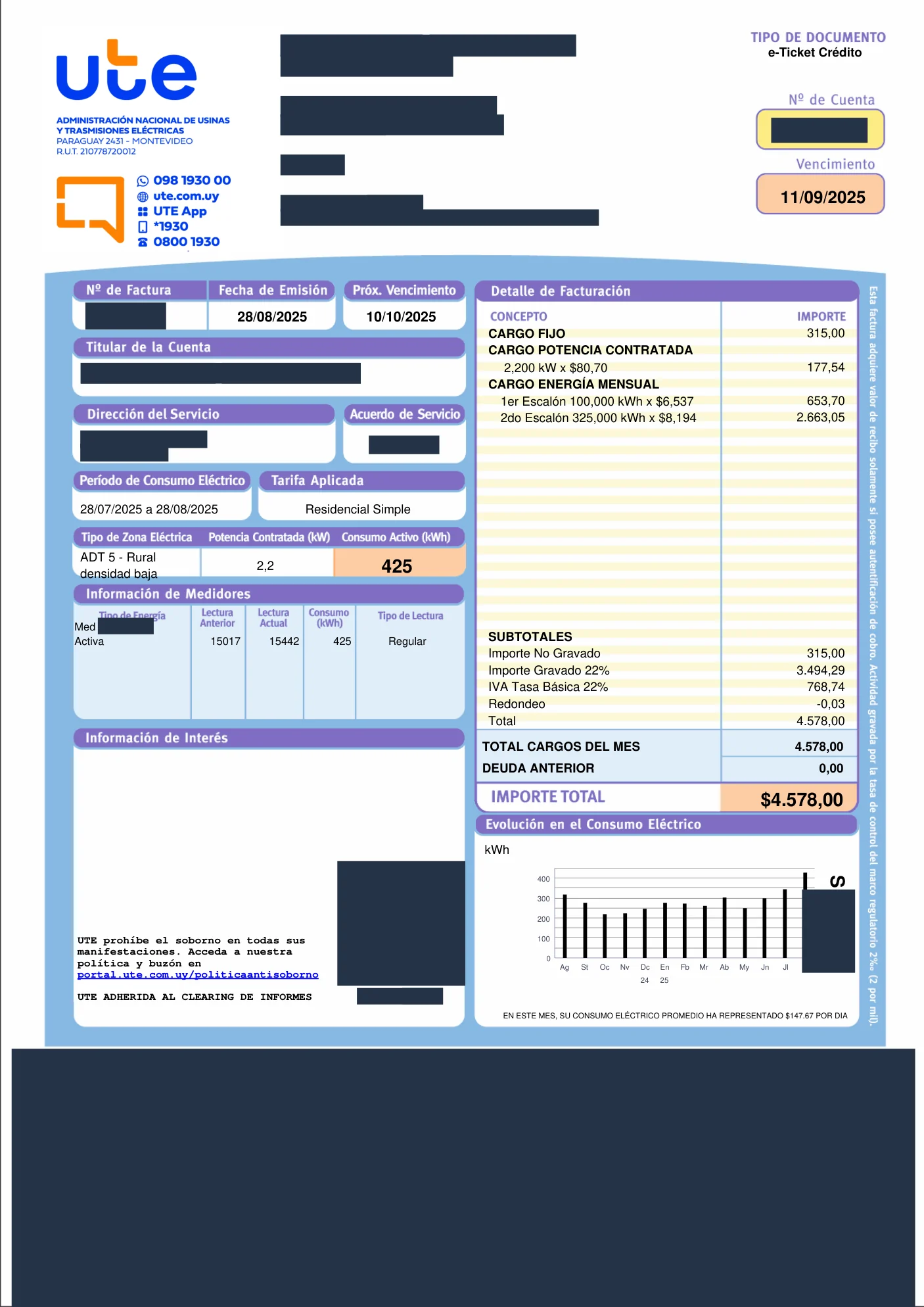
Most solar quotations start with a guess. A utility bill starts with data. For this walkthrough we worked from an actual UTE (Uruguay's state utility) bill for a rural home in Colonia - 425 kWh consumed in a winter month, on a Residencial Simple tariff with a 2.2 kW contracted power. What follows is the full sizing logic, including the regulation that decides how much PV you are actually allowed to install.
A UTE bill is a design input, not just an invoice
Four numbers on that bill drive the entire design:
- Consumption - 425 kWh, and the metering period.
- Contracted power (Potencia Contratada) - 2.2 kW. This is the number most designers overlook, and in Uruguay it is decisive.
- Tariff brackets - energy is billed in escalating blocks, so not every kWh is worth the same.
- Fixed and power charges - these cannot be removed by solar; only the energy component can.
Step 1 - Price every kWh before you size anything
Under the tariff in force (Pliego Tarifario, from 1 January 2026) the energy charge is stepped: a low first block, a higher second block, and a third block above 600 kWh, plus 22% VAT on the power and energy components. That produces two different values for a generated kWh:
| What happens to the kWh | Valued at | Why |
|---|---|---|
| Consumed on site instead of bought | second block price + 22% VAT | You avoid the marginal block you would have paid |
| Exported to the UTE grid | second block price, without VAT | Decree 173/010 pays the tariff energy price |
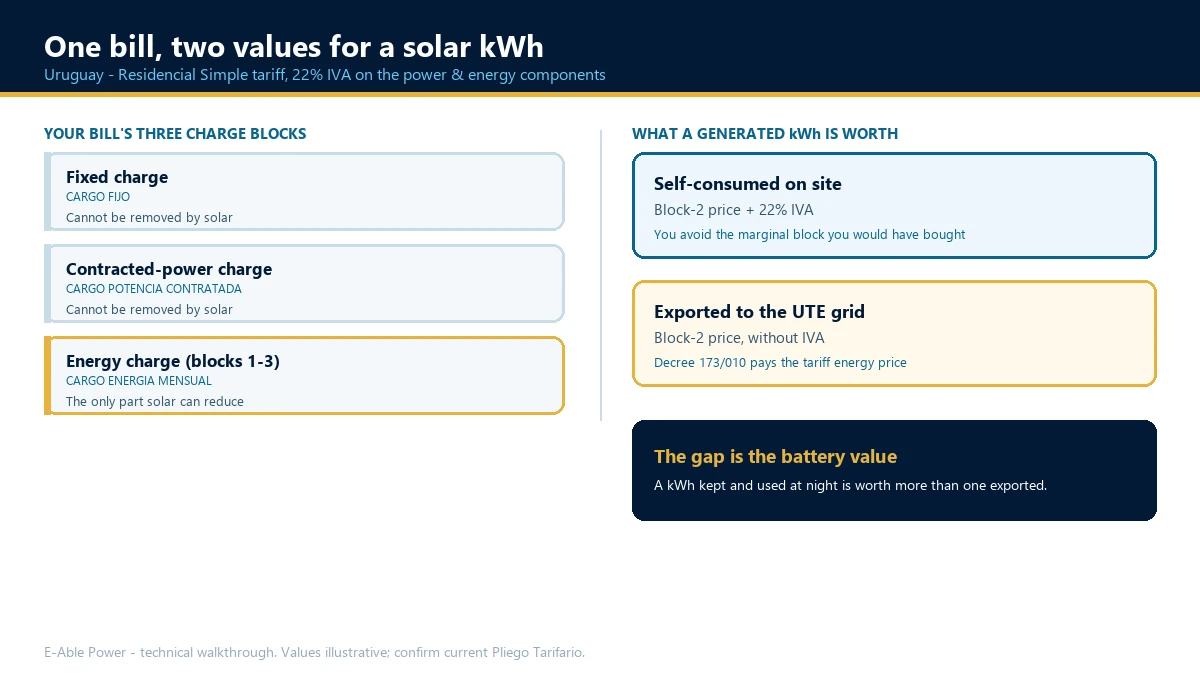
The gap between the two matters more than most buyers expect, and it is the reason a battery is worth more in Uruguay than a pure kWh-count suggests.
Step 2 - Check the site's solar resource, honestly
We used NASA POWER climatology (2005-2020) for the site's coordinates, then transposed horizontal irradiation onto a 30° north-facing plane and applied a conservative performance ratio of 0.78. That gives roughly 1,400 kWh per kWp per year - which matches the value commonly published for Uruguay, and sits below the Global Solar Atlas range for the country. Being conservative here is not modesty; it is risk management. A quotation built on optimistic yield fails in the first cloudy winter.
Step 3 - The winter/summer mismatch decides the sizing
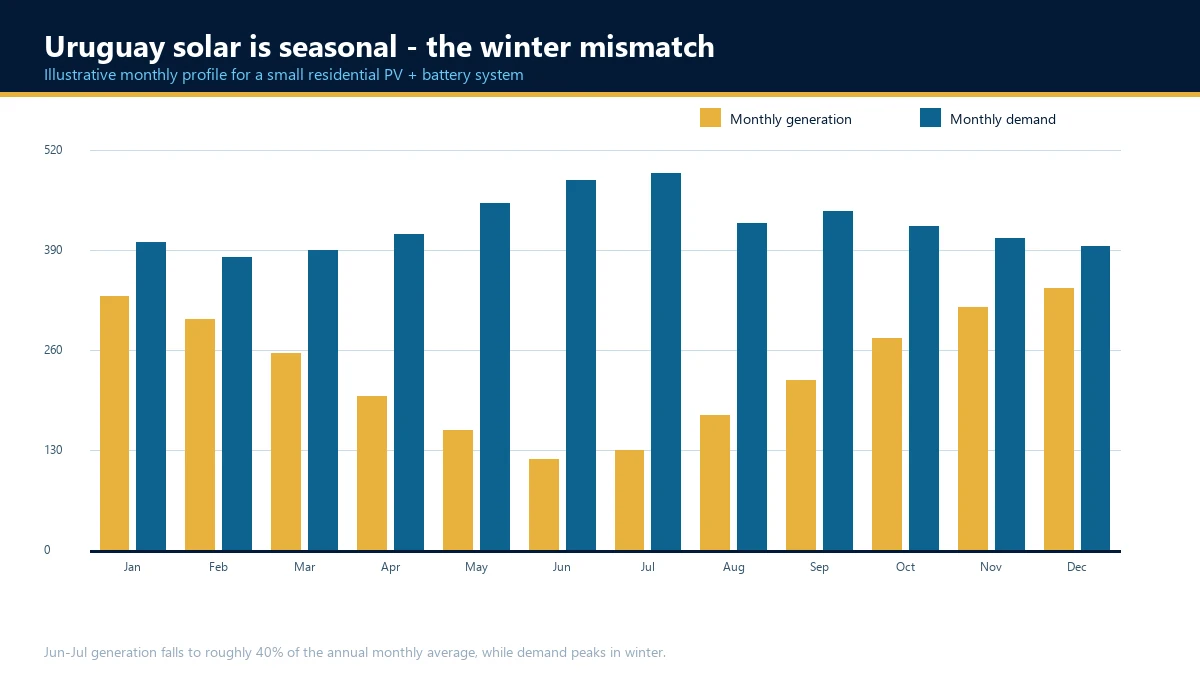
Uruguay's solar resource is strongly seasonal. At this site, generation in June-July is roughly 40% of the annual monthly average, while a Uruguayan household's consumption typically peaks in winter. The practical consequence: you cannot size a net-metered system on the best month. The binding constraint is the annual energy balance - which brings us to the regulation.
Step 4 - The rule that caps your PV: contracted power
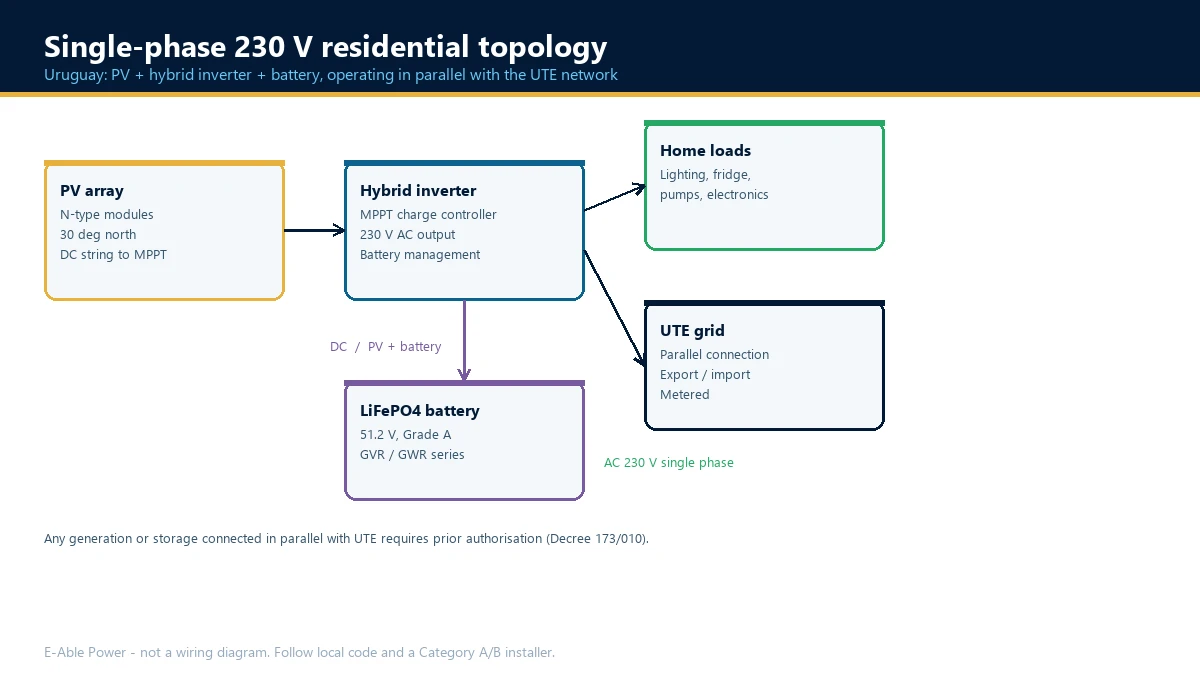
In Uruguay, any generation or storage connected in parallel with the UTE network requires prior authorisation. Three provisions of Decree 173/010 shape the design directly:
- Peak power of the generating equipment may not exceed the contracted power of the supply.
- Maximum regular current ≤ 16 A (25 A for single-phase earth-return networks) - about 3.68 kW at 230 V.
- Annual generation may not exceed annual consumption; UTE buys all injected energy for 10 years at the tariff energy price.
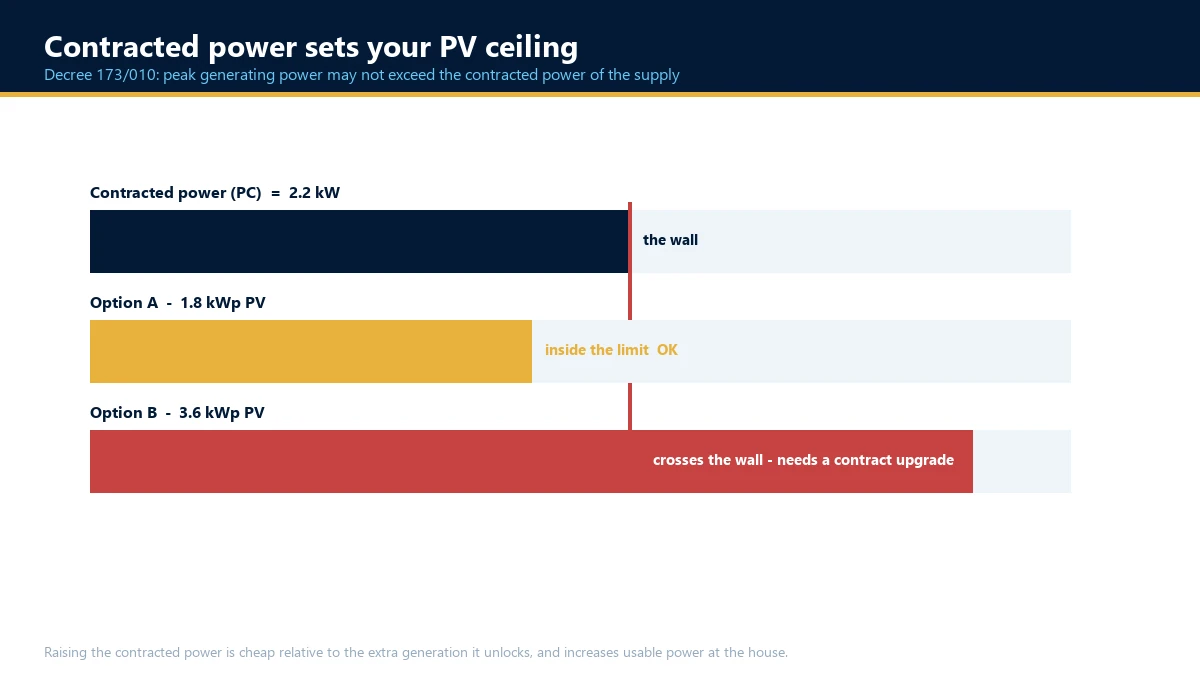
With only 2.2 kW contracted, a designer can install at most ~2.2 kWp without first raising the contract. That single number is what splits the options apart - and, usefully, raising the contract is cheap relative to the value of the extra generation it unlocks, and it also increases the power actually available to the house. Note also that since April 2026 every parallel-connected installation - under any modality - must be registered or authorised with DNE/MIEM before connection, in addition to the UTE paperwork.
Step 5 - Let the battery do the work the tariff rewards
Once the PV cap and the annual balance are known, storage stops being a luxury and becomes a value decision. In this case the daily generation of the smaller arrays stays below the household's daily consumption, so a properly sized battery captures essentially all of it - no export, no lost kWh. That is why the recommendation ladder is built around two levers, not one:
| Lever | What it buys | When to use it |
|---|---|---|
| More PV (needs a bigger contract) | More kWh generated, more bill avoided | When annual consumption has headroom above generation |
| More battery (contract unchanged) | Longer backup, higher self-consumption of what you already generate | When reliability matters, or when exports are capped |
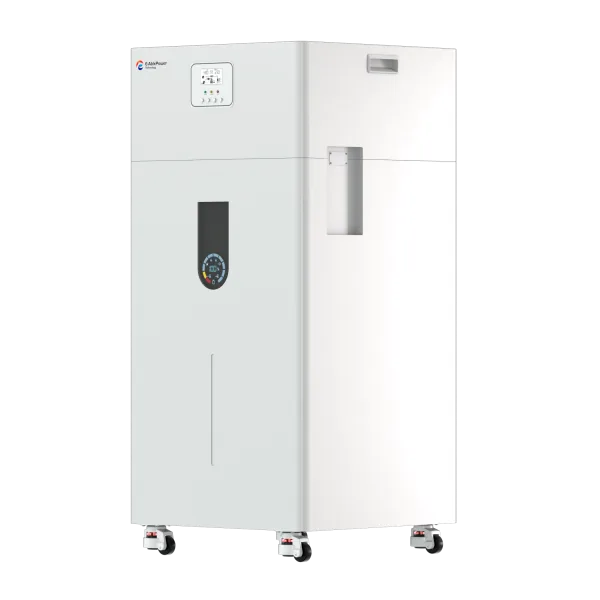
For this site, a floor-standing all-in-one ESS - hybrid inverter, MPPT charger and Grade A LiFePO4 battery in one cabinet - proved the cleanest fit: one unit to install, one unit to warrant, and no separate battery-inverter communication to commission. Wall-mounted alternatives such as the GWR wall-mounted LiFePO4 battery or the wall-mounted all-in-one ESS suit smaller, space-constrained installs, while the GVR floor-standing LiFePO4 battery and the 51.2 V 314 Ah 16 kWh vertical battery cover larger capacities.
Step 6 - Verify the string design, then the paperwork
Two checks close the design. First, string voltage at the site's temperature extremes: for a 600 W N-type module (Voc 51.41 V, -0.250%/°C) a six-module string reaches about 342 V at -5 °C cell temperature - comfortably inside a 500 V maximum and a 60-450 V MPPT window. Second, documentation: UTE requires the application form signed by a Category A or B installer, a single-line diagram, drawings, equipment technical data and a sworn declaration, followed by the connection agreement, commissioning request and energy purchase contract. If you are still choosing an inverter architecture, our guide on how solar, battery, grid and loads connect is a good starting point.
What this walkthrough is really for
The point is not that one particular home should buy one particular system. The point is that a utility bill, read properly, already contains the whole brief: how much energy you need, what each kWh is worth, and - through the contracted power - how much generation the network will actually let you install. Send us a bill and the mounting surface, and we will return the same walkthrough for your site: a monthly generation profile, a self-consumption estimate, the string check, and the authorisation route. Distributors and EPCs working across Uruguay, Argentina and Chile can also request DIALux studies and OEM/ODM configuration.
Explore the range
Start with our residential energy storage line, or go straight to the floor-standing all-in-one ESS and the GVR floor-standing LiFePO4 battery. For larger sites, see the commercial and industrial cabinets in our energy storage range. For project support or OEM/ODM enquiries, contact our team.