
Every solar street light buyer eventually faces the same fork in the road: All-in-One or All-in-Two? Both are fully off-grid, both use the same Grade A LiFePO4 battery chemistry, and both eliminate trenching and grid connection. But they are engineered for different jobs . This guide breaks down the real differences — installation, output, maintenance, and cost — so you can specify the right configuration the first time.
What Is an All-in-One Solar Street Light?
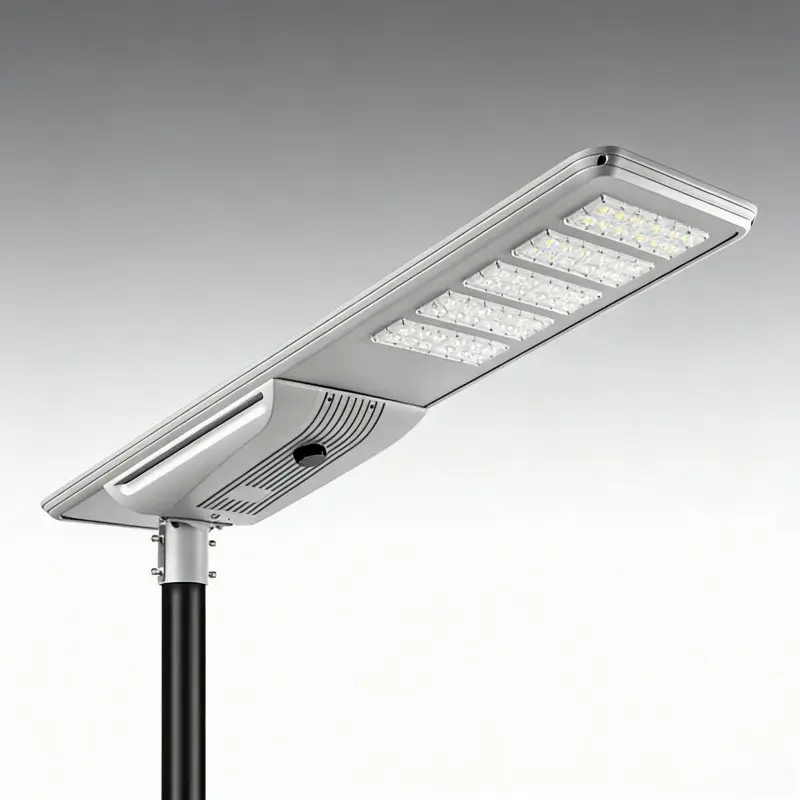
An All-in-One solar street light integrates the solar panel, battery, LED module, and controller into a single fixture that mounts directly on the pole top. There is no separate panel, no field wiring between components, and no visible cable run.
Installation: one-piece mount — typically under 30 minutes per pole.
Appearance: compact, modern, and discreet.
Best fit: residential streets, parks, campuses, pathways, and retrofit projects where speed and aesthetics lead.
What Is an All-in-Two Solar Street Light?
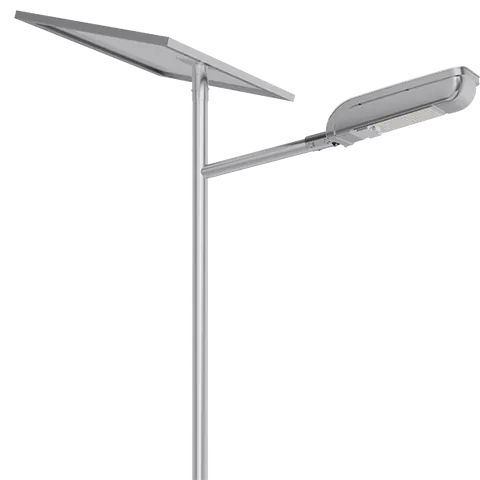
An All-in-Two (or split two-piece) solar street light separates the solar panel from the lamp head . The panel mounts on top of the pole (or on a dedicated bracket), connected to the lamp by a short weatherproof cable. The battery sits inside either the panel housing or the lamp housing.
Installation: two mounting steps + one cable connection.
Appearance: conventional street-light silhouette with a visible panel.
Best fit: municipal roads, industrial zones, and sites requiring higher output and longer autonomy.
Head-to-Head Comparison
How to Choose for Your Project
Choose All-in-One when:
Installation speed is critical (large rollouts, short construction windows).
The site is residential or community-scale with moderate lighting needs.
Aesthetics matter — a clean, fixture-only pole top.
You want the simplest possible field inventory (one SKU per site).
Choose All-in-Two when:
The road or area demands higher lumens and longer autonomy .
The site has partial shading at pole-top level (panel can be oriented independently).
You need a larger panel for higher-latitude or winter-dominant climates.
Future component-level upgrades matter (swap panel or lamp separately).
Best practice: many municipal projects mix both — All-in-Two on main arteries, All-in-One on secondary streets and parks. E-Able Power engineers can model either mix in a free DIALux simulation.
Frequently Asked Questions
Q: Which type lasts longer?
Both use the same Grade A LiFePO4 battery chemistry with 2,000+ deep cycles and IP65-sealed housings. All-in-Two has more connection points (one cable) but each component is more modular to service. With correct sizing, both comfortably exceed a 5-year service life.
Q: Can All-in-One lights be used on main roads?
Yes, up to 200W-class outputs in E-Able Power's range — but for wide collector roads with tall poles (8m+) and high lux targets, All-in-Two is usually the more economical way to reach the required output.
Q: Do you provide free lighting design?
Yes. Send road width, length, pole height, and lux target — we return a DIALux simulation and a confirmed configuration within 2–3 business days, free of charge.
Specify Confidently with E-Able Power
E-Able Power manufactures All-in-One solar street lights and All-in-Two solar street lights factory-direct, with OEM/ODM support, CE/RoHS compliance, and a 5-year warranty. Delivery experience spans 60+ countries.
Request a project quote: sales@e-ablepower.com · WhatsApp +86 153-5558-9600
Have a solar or storage project?
Send your site conditions for a system engineered to your location — DIALux simulation, sizing and pricing within 2–3 business days.